


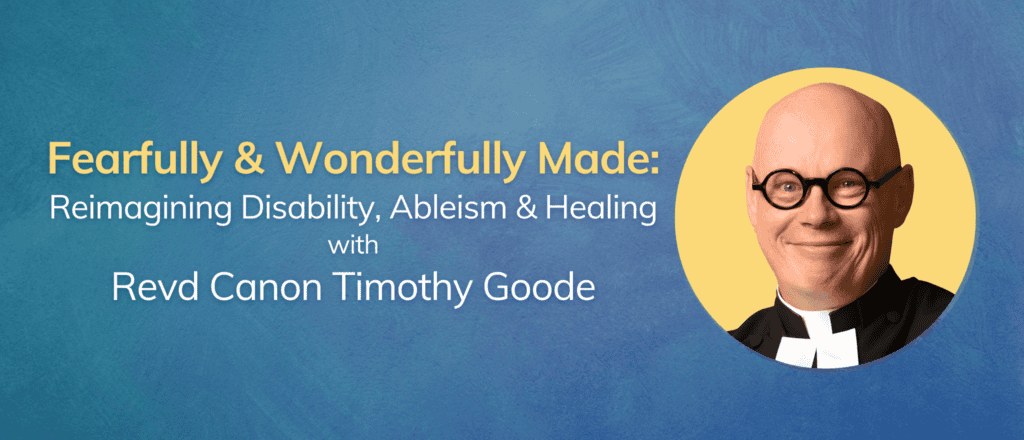
In this powerful episode, Rev Canon Timothy Goode joins Gillian Straine to explore disability, ableism, healing, and what it means for every person to be “fearfully and wonderfully made”. Through Tim’s story and theology, the conversation challenges the church to move beyond access as compliance and towards a deeper imagination of belonging, agency, vulnerability, and the risen body of Christ.
In this episode:
In this episode of the GoHealth podcast, Gillian Straine speaks with Rev Canon Timothy Goode, priest, theologian, author, and Canon for Congregational Discipleship and Nurture at York Minster, about disability, ableism, healing, vulnerability, and the church’s imagination.
Drawing on Tim’s personal story of cancer, paralysis, rehabilitation, ordination, and daily prayer with Psalm 139, the conversation explores what it means to be “fearfully and wonderfully made” at every stage and in every condition of life.
Tim challenges the church to move beyond access as a matter of ramps and compliance, and towards a richer theology of agency, belonging, and the risen body of Christ: scarred, storied, limited, and gloriously held in God. Together, Gillian and Tim consider how healing ministry can honour the whole person without trying to erase pain, disability, history, or vulnerability.
This episode explores:
- Tim’s lived experience of disability, cancer, paralysis, rehabilitation, and ministry
- Why ableism is about more than disability, and how it shapes church culture
- The difference between access as compliance and access as agency
- Why “I am fearfully and wonderfully made” can become a daily act of truth-telling
- How buildings, pulpits, welcome teams, and worship spaces “preach” who is imagined and who is not
- The danger of idealising strength, independence, and the “perfect” body
- Why the risen body of Christ offers a better Christian anthropology: scarred, storied, and imaginative
- How healing ministry can centre consent, dignity, story, and belonging
- Why vulnerability and limits are not failures, but sources of imagination and transformation
Resources mentioned:
Breaking, Not Broken by Rev Canon Timothy Goode
GoHealth’s Everyday Healing course
Transcript
Gillian Straine: Welcome to the GoHealth podcast. I’m Gillian Straine, Chief Exec of GoHealth, an organisation with a vision to enable churches and individual Christians to be a healing presence in the world. And on this podcast, we have conversations to inspire and equip us all to connect health and faith in our everyday life. And today, I’m so excited! The guest we have on the podcast today is Canon Tim Goode. Tim is a priest, a theologian, and an author, and currently he’s Canon for Congregational Discipleship and Nurture at York Minster. And with previous hats on, Tim’s also served the General Synod of the Church of England and the Archbishop’s Council as Disability advisor. Tim, welcome to the podcast. How are you this morning?
Canon Timothy Goode: I’m all right. No, it’s great to be here. Really good to be here.
Gillian: And we’ve got lots to chat about. But just say you just published, a book. It’s called ‘Breaking, Not Broken’. We’re going to get into it, in this conversation. It says it’s a critique of ableism. So I want to understand what that’s all about. But I just picked up, one of your, reviewers or, person who commended the book. They’re an Anglican Bishop, and she says this: ‘It’s a strong and at times uncomfortable challenge’.
Tim, why are you making people uncomfortable, do you think?
Tim: Well, firstly, ableism isn’t a term that many people use, so that immediately challenges. But when they do use it, they link it to disability. Ableism is much more than that. It sits further upstream, and so it’s challenging all of the way the church discriminates.
So that’s that’s why it is particularly challenging.
Gillian: So it gets into why the church is discriminating more broadly…
Tim: right across the board.
Gillian: And that’s making people uncomfortable, why?
Tim: Well, because it it starts to challenge their own perceptions, their own stories. And that, as you can understand, can make people feel very vulnerable.
Gillian: So let’s get into all that. But we, we’ve known each other for a while, haven’t we, Tim? We met at theological college. Do you remember?
Tim: I do remember, yes. I mean, we were in the same year together, if I remember right. Oh, we certainly finished at the same time.
Gillian: Yes, I think we had two years together and, yeah, we finished at the same time, but we didn’t really have a proper conversation till, I think, the final week of college…which seems…
Tim: It was it is worse than that. It was the final day.
Gillian: Oh, yeah. That was a that was a bit of a miss.
Tim: And, and it was only then that we realised that we, we share the story of cancer.
Gillian: Yeah, yeah, yeah.
Tim: And I think that slightly blew both of us away, that we’d spent two years, often in the same room in lectures. And, we’d never shared this. So never. You know, really knew this of each other. Yeah, yeah.
Gillian: And what I remember of the conversation was gah! we could have really…we’d lots to talk about. And what, what I also remember is, and this is what we’re going to get into around ableist and disability and the scars we carry. My scars from my cancer experience, which was being diagnosed, with advanced cancer at 21. My scars were almost entirely invisible. Whereas for you, your experience, you carry quite visibly, don’t you?
Tim: Yes. I have a bone condition called multiple exostosis. So in my childhood, I was in and out of hospital having little bony spurs being chopped off. And, and so I suffer quite a lot of childhood trauma just through having a lot of, operations, but also relationally. I was at boarding school. Children don’t get people who are constantly changing.
Gillian: Oh I think grown ups don’t get that sometimes, too.
Tim: But when I was in my mid-twenties, one of these lumps grew cancerous, and, and it was a dumbbell tumour growing down into my lungs and through my neck and down into my spine. And it left me paralysed, from the chest down. I’m still permanently on crutches. I use a scooter, but I’m yeah, literally covered in scars.
Gillian: And if it’s okay with you, can we can we just, dive a little bit into that moment because you really just skipped over that very quickly. I know, you know, you got to cover a lot quickly, but ‘I was paralysed from the chest down’. I mean, was this something you were expecting, given the condition or this new tumour? This. This really was a turning point.
Tim: Oh, no, this was this was not part of the narrative of being shared at all. Yeah. I was, told that these bone spurs had stopped growing when I was, you know, when I stopped growing. And that really would be the end of the story. And so this came as a a real shock. And the actual process, I thought I was becoming unfit. That’s how it manifests itself. But gradually my spine was collapsing. And so I was rushed into hospital and diagnosed. And it was through the clearing of the cancer from, from my spine that the damage was done. It was inevitable. I mean, I was disintegrating at quite a severe rate even before I got into hospital. So but it was not what I was expecting. It came completely out of the blue and was devastating.
Gillian: It must have been, because it changes your whole future, doesn’t it as well.
Tim: Yes.
Gillian: Not as everything you’d imagined. What else was going on in your life at the time, were you, part of a worshiping community? What was going on for you?
Tim: Yes, I, I, I went to church. I think my faith was important to me. I think, on hindsight, my dad’s a vicar. I think I carried my parent’s faith. I don’t think I was really questioning, I think I took as read what had been shared with me as a child. And nothing had really happened in my life that would challenge that. This most certainly did challenge it. And so I sort of I had quite a hiatus after my time in hospital. I wouldn’t say I stopped believing, but I did, in a sense, throw my hands up in the air and said, I don’t understand. And I lived… I was quite comfortable living in that state of not understanding.
I mean, the turning point was, I’d only just been married a year when this happened, so it was devastating for Bernie, my wife as well. You know, who was having to, you know, engage with the reality of being a widow at 26. But it was the monk who married us who came to see us, saw me in intensive care, and I just railed at him.
How on earth could this be allowed to happen? And all of that. Just absolutely railed at him. He just listened. He then held silence, and then he just said to me at the end, do me a favour. Say Psalm 139, verse 14 at the beginning of each day, maybe when you’re brushing your teeth. And then he got up and left and just left, left me with that, Psalm 139, verse 14 is, ‘I praise you because I am fearfully and wonderfully made’.
Gillian: Wow.
Tim: And I can say this with hand on heart, that for the last 30 years, every single morning I have said that. At first it was an incredibly difficult thing to say because I felt anything like, you know, that Psalm. But gradually over time, it became, it’s become a barometer for me. I know how I am by how it lands each morning, if it catches in my throat, if I’m not a lot of pain, I know I’ve got to go and do some work.
So, you know, sometimes it’s incredibly easy and I absolutely believe it. My day always starts with that conversation.
Gillian: Thank you for sharing that with as well. I feel removed hearing that. And I and I’m really curious about you using it as a barometer as well to tune in, to tune into that truth and what you’re and your reflection there that sometimes it isn’t easy to keep believing. I wonder whether that’s an important thing for all of us to hang on to as well, that just because we have faith that we’ve given our life to Christ for whatever language you put round that, it doesn’t mean that at all. All the problems disappear.
Tim: No.
Gillian: It sounds a bit like a decision or a discernment for you, almost every single morning for you.
Tim: What it does do is it puts my day into a context. I’ve always viewed my faith as finding…with a context through which I live my life. It doesn’t change the realities of life – pain, suffering, joy, all that, that diversity of life. But it does provide me with a real anchor, a real context, through which I would be bereft without.
Gillian: And Tim, you taught yourself to walk again. You said you…yeah.
Tim: With the help of physiotherapists. Yes. I spent a considerable amount of time in rehabilitation, and so I managed to get myself, onto my feet and on crutches. I was, I was very, very motivated. I mean, I was, I was lucky in that I had considerable lived experience to fall back on. Because of having had so many operations where I would not be able to walk initially and then have to get walking again. I had a lot to fall back on to help motivate me.
Gillian: And you’re an ordained priest in the Church of England. What was the process of discernment like for you which presumably came after this.
Tim: Bumpy.
Gillian: Tell us about the bumps.
Tim: Well, I mean, for 12 years after my operation, I managed to get back to work. I was a director of music and my…at the school I taught in were stunning. They were absolutely stunning, and it was only when I put myself forward for ordination that I experienced any really strong discrimination.
Gillian: Waow God, what did that look like?
Tim: That everything about the church was reactive. So and no thought was ever given to people like me. So there was a within the church, a failure of the imagination around me.
You know, when I arrived back at school, they’d already put a lift in. They’d moved my classroom. They’d come to my bedside and talked, to talk through with me and gave me real agency. So when I arrived, nothing was a surprise. You know, and the support I got was extraordinary. There was none of that with the church at all. And so I was always seen, well, not always seen. There were some people who were extraordinarily kind and helpful, but it was I was always a problem to manage.
Gillian: So is it, more a lack of, as you say, imagination, a lack of enabling your agency. So there was just things missing rather than proactive.
Tim: Well, the church is very good at catastrophising. So all the questions would be, could I cope, would I manage? You know, I felt, am I going to be a burden? There was a really strong emphasis that I was hearing back, you know, that ministry, belongs most naturally to the strong, the energetic, the endlessly available, you know. And so to offer a different narrative was one that the church struggled with.
Gillian: And and Tim, is that ableism. Can we just get into it?
Tim: Yeah, that’s most definitely ableism.
Gillian: Yeah.
Tim: I mean, ableism is… how would I put it? It’s the, it is the assumption that certain bodies and minds are more normal or more valuable, more capable, even, I would go more desirable than others. So it’s a hierarchy of bodies.
Gillian: So I, I don’t live with disability. So that’s not my experience. But listening to you talk about it, this seems, you know, wrong. We’ll get into the theology in, in a second, but also quite hidden. I mean, if we talk about disabled access, it often boils down to ramps. And do we have a ramp? Yes. No. And that’s a clear are we discriminating, are we not? But what you’re talking about is a sort of collective sense of what’s best. And that’s that’s almost, harder to spot and call out than actual proactive discrimination. This is the culture. It’s a culture thing, isn’t it?
Tim: It absolutely is. And, and and this is what my book is seeking to offer an answer to, or one of the answers to it. I mean, I think there is a real issue about what do we mean when we say that we are made in the image and likeness of God? People certainly do not imagine that being on crutches is being made in the image and likeness of God. Or being in a wheelchair, you’re not made in the image and likeness of God. And that is really, really difficult when that is being projected upon you, that you’re less than.
Gillian: And how do you think it shows up for people that that want to be allies and understand it more? How does it show up day to day for people who live with disability?
Tim: I think it shows up when people are not asked. They’re not involved in decision making. People make assumptions. People actually project onto the person involved, their own fears and their own catastrophising. I used that word before, you know. Ableism is also when people are idealised. “Oh my goodness me, Tim, you are amazing. I don’t know how you do it. Oh, Tim, you’re always smiling.” And so it’s just as hard being put on a pedestal.
Gillian: How do you respond to that?
Tim: Well, I struggle to get onto pedestals.
Gillian: Okay. [Laughter]
Tim: Number one.
Gillian: [Laughter] So that’s easy.
Tim: I mean, it’s…that also requires a discipline because it is seductive. I mean, I’ll be absolutely, you know, you know, I mean, I hope we all want to be the best form of ourselves.
Actually, that is not the best form of myself, but it could easily become believing that. And it’s hard because then do I therefore tell people what I’m in pain? I don’t want to tell people I’m in pain. It’s hard enough managing it on my own. Than actually then having to manage other people, managing it.
Gillian: Yeah.
Tim: You know, so that becomes unnatural. So there’s no simple answer to it. It is something that that needs just constant attention. So in itself it is time, it is a, it’s an extra burden, I would say, of being visually, visually disabled.
Gillian: Yeah. That’s patronising as well. And it’s, is it shutting, shuts you down. If somebody says to you, I’m just reflecting about my own, my experience of cancer, you often get, oh, you’re so brave, blah blah blah, or you look so good, blah, blah, blah. And and what I learned to hear was, they’re saying, “don’t talk to me about it”. You know, that’s, you know, that sounds like it’s part of what you have to navigate so often as well.
Tim: Or they like, they like you to talk about it. So people like that story of I’m fearfully and wonderfully made. That’s a story people do like. They do like stories that they can relate to that isn’t going to necessarily mean that they’ve got to imagine being in the same place. So you then start to own the narratives that land and dismiss the narratives that don’t land, which itself is not a healthy place to be.
Gillian: And it must be isolating, you know, if one goes down that path too far, you isolate yourself.
Tim: Yes you do.
Gillian: It’s often the reality of what’s going on and and how do we…it’s a question for, for everyone but maybe leader people who are sort of front facing in some way as well. It’s it’s a broader question around how we display or how we let people see our vulnerabilities.
Tim: The theology I’m engaging with on ableism is not the domain of disability. As I said earlier, it is everybody. It’s a theology for absolutely everyone. I mean, I was on the DAC and [transcription unavailable]
Gillian: And remind our listeners, what the DAC are…
Tim: That’s a diocesan advisory council. It’s it’s the planning body for the Church of England, the buildings. And the thing I like time and time in meetings when we were talking about access because, you know, I was advising on access, amongst other things, and I kept saying, please, please, this is access to freedom of thought. The ramp give gives agency to the disabled person to make their own decisions about entering into somewhere.
Gillian: Wow
Tim: Always…access to freedom of thought. So welcomers for me, are a nightmare on the whole because I know the ones who see me coming, and it’s as if all of their Christmases have come at once. Here is someone I can help. And actually, what they are doing is putting all of the barriers that they can then remove for me, that they want the barriers there for them to then remove.
Gillian: Yeah.
Tim: We used to when we were down in London, we used to go to the Festival Hall a lot, and there was a steward who would always walk me to my seat. I got, I ordered the same seat. I knew where it was. I was more than capable. She would not allow me to walk to that seat on my own.
Gillian: So you end up meeting the needs of those around you who are trying…
Tim: Oh…all the time.
Gillian: I’m really struck Tim, with that phrase, when talking about ramps, presumably, and automatic doors, on a committee of that looks at building access, you have that phrase ‘you’re giving people access to freedom of thought’. It sounds to me like you’re you’re introducing theology into questions around buildings as well. Can we get into, what are the main theological underpinnings of ableism? Where do you go to drive the culture change you want to see in the church?
Tim: Our buildings preach. They they preach the values of those who built them. The values of each generation who have inhabited them. They speak of our values as well. So the first thing is therefore interpreting the buildings and the stories that they tell. And then it’s asking, so what are the stories that we want to leave? So that’s just about engaging with heritage. The question I’m constantly asking here at York Minster, I’m drawing people’s attention is people like me were not imagined in this space. An example I could give is our pulpit was built in 1929, ten years after the end of the First World War, where hundreds and thousands of people returned traumatised physically and mentally. And yet nobody imagined that any of those could preach the word because it’s utterly and totally inaccessible. So I preach from the floor and everyone can see the pulpit, and they can see the disconnect – that’s telling a story. We’re drawing attention. People should be asking questions of that, that disconnect.
Gillian: And theologically, what do you point them to, to help them move on in terms of their spiritual life. To really get this, to get the changes we need around ableism in the church?
Tim: Well, I ask, what’s the human being you are imagining in this space? When we talk about a priest, when we talk about a preacher, in your mind’s eye, what do you envisage? Because it’s not the risen body. And what I am drawing attention to or exploring is has the church by accident, I’m not saying necessarily by design, actually taken on a heretical anthropology. That’s actually when the church moved from being an oppressed sect to being the Imperial Church of Rome, which happened here in York. Constantine the Great was crowned. You know, where the steps of the south door of the Minster are. That’s where he was crowned. And so Christianity then became the organised the, the the religion of imperial, of empire. And so it moved into the buildings of empire. So it moved into basilicas, it moved into the town halls and those buildings were built to preach a theology of the idealised norm of the Greco-Roman, perfect human being.
Gillian: And why is that heretical?
Tim: Because the problem with the idealised norm is it’s static. It just is. Think of the Vitruvian man of Leonardo da Vinci, that perfect figure. All that perfect figure is interested in is its own survival and its own pre-eminence. And people aspire to it. Why do you think people going to gyms, why do you think people are having corrective surgeries?
You know, trying to hold off aging and all of that is actually is because we have this anthropology of perfection of the idealised one, that perfect being. We see it so much in our advertising and so on and in the people who get into power. And so on, we see, we see all of this. Just look at the imagery that Donald Trump is trying to portray of himself is absolutely the idealised norm.
Gillian: And cage fighting on the lawn of the white House.
Tim: Yes.
Gillian: Show of strength.
Tim: It’s all about strength. And that perfect body, therefore, also takes on the mind that would inhabit that perfect body. And it is utterly unimaginative. Whereas a Christian anthropology, I’m arguing, is the risen body of Jesus Christ. That is the body that is ascended to the father. That body is profoundly imaginative. It’s storied. It’s not static. It tells, because it’s it is beyond death, it shows the story of his passion, of his crucifixion, of his resurrection. And so it becomes a place where your story can be told, where my story can be told. Everyone’s story is held and honoured and valued.
Gillian: It’s a scarred body, are the scars important?
Tim: And the scars tell that story. And it and it states that it’s a limited body. It is one where we actually learn and grow as much through our scars and our vulnerabilities. Our vulnerabilities, bizarrely, are God’s great gifts to us.
Gillian: Tim at GoHealth we, we do a lot about connecting health and faith. And we also do a lot of teaching around the healing ministry that is one of the two things Jesus asks us to do. He asks us to make new disciples. He asked us to, give healing to others.
So often I say to people, I could start a whole healing ministry, healing bad healing ministries. Because and at the root of bad healing ministries is an understanding that healing means getting back to normal.
So I imagine for, in the areas we’re talking about today, the healing ministry might be a key point of inflection. How can churches, Tim, offer healing ministry better? In general, not just for those living with disability, but what lessons can we learn?
Tim: I think it’s profoundly significant that Jesus so often preaches in public and heals in public. I think there’s again, there’s also around the agency of the person who’s being healed. But there’s something I would want to challenge the church about their imagination around healing. I mean, I have had healing forced upon me. So I, I’ve been seated and people have come and put their hands upon me so that I’ve been stuck in a chair and not been able to move while they prayed over me without my consent.
Gillian: Wow, that’s terrible, isn’t it?
Tim: So and that’s happened on multiple occasions. So there’s…so consent is absolutely vital. But also this, this imagination that I am healed if I throw down my crutches and walk, that is healing to the idealised norm. That is also doing terrible damage to my story, and actually seeking to erase 30 years of my life saying it is of no value whatsoever.
And I’ve found being on the receiving end of that deeply distressing, and I’ve had to go away and do some real work on it. I think we need to talk about healing to the risen body of Jesus Christ. Speaking for myself, of course, if you’d spoken to me when I was in the hospital bed 30 years ago, am I praying for my supernatural healing? That’s utterly what I wanted. Of course I did.
Looking back now, 30 years on, I would be bereft without the lived experience of what I’ve accrued over the last 30 years. I would be absolute bereft of the investment that people have placed in me, in the way they’ve cared for me. The learning that I have received through it, the people I’ve been privileged to be alongside because of it.
I would not have been ordained without it. I, I would be utterly bereft without the last 30 years. That is healing. That I’m at peace with what has happened, that it is that I know it is part of the story that is Tim and it is a vital part, not, you know, of that whole story, just as every relationship I have is part of that story, just as my relationship with my wife and my friends, my dog, my work, you know, all all of that is the story of Tim.
This is where our identity as is understood as storied rather than static. And the problem, again, with the imagination of the church when it comes to healing, is it’s static. And the risen body, our faith tells us that our identity is storied, not static, and our healing must not, must be about the ending of that story.
Gillian: I keep going back to that phrase, Tim, that you get up and say to yourself in the mirror each morning, “I am fearfully and wonderfully made”. Because there’s something in that of the dynamism of…of what you’re talking about.
You say at the beginning of the day, before you face whatever you’re going to face, however, you’re feeling…
Tim: The beauty of the phrase is, it’s not you telling me, it’s me owning it. I praise you because I am fearfully and wonderfully made. Who cares what anyone else thinks. That, that the psalmist is stating I. I know it for myself. It also asks a question, because the question then must follow if that’s true, if I am fearfully and wonderfully made, when am I fearfully and wonderfully made? Is it when I’m in the womb? Is it when I’m just born? Is it when I’m five, ten, 20, 30, 50, a hundred? Is it when I’ve got cancer? Is it when I’ve got dementia? Is it you know, whatever. And if, as I believe it is, at all of those points, I’m fearfully and wonderfully made, then you’re never more dependent than when you are in the womb. You’re never more disabled then when you’re just born. Our identity in God is at each and every single point, and healing is being returned to that identity in God. And the knowledge that we are fearfully and wonderfully made.
Gillian: And because it’s, for each of us and we’re also part of the body of Christ, the church that then gets us into the politics of the church, doesn’t it? What does, what can and should the church be doing right now, around this issue? Give us a list because we don’t have time to get into them all. And I know you must have a big list. Okay?
Tim: I mean, you know, Paul was was ahead of us, Paul, before we became the imperial religion of Rome, you know, gave us a theology of the body. Now, Paul’s theology of the body itself came out of lived experience.
I believe that Paul’s conversion was the walk into Damascus, that moment where he moved from being his self identity as someone independent, strong, coherent, became utterly and totally dependent on those around him to the point that he’s baptized by the very person he set out to destroy. And I think that shook Paul to the core, and he spent the rest of his ministry making sense of that seminal, life changing event.
And his theology of the body comes right through that lived experience. So therefore we need to the church needs to be asking, who are the voices we are missing? Who are the voices that were not here? Who are the voices we have not acknowledged? Who? Who have we not asked? Those are the questions we need to ask, because we will not be the body of Christ until all are engaged and all are valued, and all are part of that story.
Gillian: You have said time and time again in the course of this conversation, the church needs more imagination. And that and I was really struck in your writing, Tim, do you have a phrase or an idea that it’s our limits that give us imagination? How can we better engage with our limits in order to improve church and culture?
Tim: Well, we’re terrified of our vulnerabilities. It’s it’s one of the, you know, one of the the real challenges we have is a culture that’s terrified of vulnerability. And yet, if you look back to our ancestors, the person who, who got to the edge of the river, the edge of a river and looked across, how am I going to get to the other side? I’m limited. I don’t know how I can get to. I can’t do this. So they had to engage with their imagination and over generations of engagement, they invented the bridge and we crossed. We have the same with stairs. We can’t jump eight feet in the air. We have to engage with our limits. And it’s through that engagement, through imagining what it could be we invented the stairs. We invented the plane, we invented the train. And one of the privileges of all of my experiences of being in hospital has been the profound empathy of people alongside me, imagining and coming up with solutions, seeing the limits, imagining themselves in my position, and engaging and coming up with solutions that every treatment, every adaptation, you know, the sliding door, the lift, everything comes out of us engaging with our vulnerabilities, our vulnerabilities are our superpower. They are the very means through which we then imagine. If we were limitless, then we would not need to imagine.
And the risen body is a limited body. Jesus needed to sleep. Jesus felt pain. Jesus got angry. Jesus got frustrated. You know, Jesus…God engaged and lived in limits. And, and that engagement, that deep engagement is now ascended to the father. It’s part, that’s who God is. And God knows. And God understands and God gets it.
So we should not be afraid of our, of our limitedness. I’ve had to reimagine my life in the face of what, what what has happened. And I’m continually reimagining it as my shoulders give up on using crutches. I’m having to constantly engage all the time in that story. And what might the story continue to be? That’s a good thing.
Gillian: Tim, thank you so much for sharing your work, your story, your book, and inspiring me, and I’m sure people who are listening, to think about limits, to think about imagination and to think about who’s not in the conversation right now. I’m so glad that GoHealth is tuning into your work and to these questions.
And, Tim, I’d love to keep exploring with you how this work and this significant challenge is taken forward.
Your book. Tim, I don’t know why I’m telling you. I’m telling everyone who’s listening. The book is called ‘Breaking, Not Broken’. It’s available, everywhere you normally buy books, and we’ll put details and links in our show notes so people can easily access that.
We are just about to release, the next evolution of our Everyday Healing course, which dives into the theology and practice of being a healing presence in the world. And if you’re curious about what Tim has raised today, this course will invite you into the questions with your imagination, into the theology, the history and practice of the healing ministry that attends to human flourishing without skirting around the pain and reality of being a human.
All the information about this online self led course and all of our work can be found on the website. A huge thank you to Rosie Dawson for producing this podcast, and to Wendy Lloyd for all her work on both the podcast and the GoHealth community. So until next time, thank you for listening and may you know God’s healing presence in your life and in the world.
Dive deeper with GoHealth

Are you a leader?
GoHealth, we support leaders to flourish personally and in their teams. Through theologically grounded and scientifically informed training, coaching, and reflective practice—online and in person—we help leaders nurture wellbeing, build healthy cultures, and lead with clarity and purpose. Our approach is trauma-aware, values-driven, and designed for those shaping organisations that make a meaningful, positive impact in the world.

Join the mailing list
It’s the best way to hear about all of our upcoming courses, events and news.

Explore our online courses
There are lots to choose from! Perhaps you are interested in mental health, healthy working, or being trauma informed.