





We are living in unsettled days. Sometimes it feels as though each hour brings another “breaking news” alert: escalating conflict in the Middle East, deepening political fracture, economic instability, institutional strain. Even at a geographical distance, we feel the tremors.
The question many leaders are quietly asking is this:
How do I remain steady when the wider system feels increasingly unstable?
At GoHealth, we speak often about vocation, our call to be healing presences in the world. In anxious times, that calling becomes both more demanding and more necessary.
And at the heart of that calling is one word: belonging.
Belonging Is Biological
Why is belonging so essential?
Because loneliness kills.
That is not rhetoric; it is epidemiology. Large-scale studies led by Julianne Holt-Lunstad et al demonstrate that chronic social isolation significantly increases mortality risk comparable to smoking heavily. Loneliness raises the risk of cardiovascular disease, stroke, dementia, depression, and immune dysfunction. It elevates cortisol, disrupts sleep, and increases systemic inflammation.
The body reads prolonged disconnection as threat.
Belonging, therefore, is not sentimental. It is biological. The nervous system regulates in relationship. We calm one another through tone of voice, steady presence, shared attention, and touch. To belong is to become safer in one’s own body.
For leaders, this is not peripheral knowledge. It is foundational.
Belonging Is Formative
Belonging does more than protect us physiologically. It shapes identity, meaning, and moral imagination.
In Who Do We Choose To Be?, Margaret Wheatley argues that we are living through civilisational unraveling: ecological strain, institutional fragility, political polarisation, erosion of trust. Complex systems in decline do not reform neatly; they fragment.
Her question is not, “How do we fix everything?” but, “Who will we choose to be?”
Wheatley speaks of creating “islands of sanity”, relational spaces where integrity, calm, and compassion are preserved even when the wider system is chaotic. These are not escapist enclaves. They are stabilising presences. They endure. And by enduring, they influence.
This reframes leadership. The task is not omnipotence. It is formation.
It also reframes vocation.
Vocation: Calling as Identity
Vocation is not first a job description. It is calling. And calling is about who we are before it is about what we do.
To speak of vocation is to speak of identity rooted in belonging: belonging to God, to community, and to a purpose larger than personal ambition. When we discover our vocation, we are not inventing ourselves; we are responding to an invitation woven into our very being.
And when we practise that calling, we flourish.
Flourishing does not mean ease. Many vocations are costly. Some require us to stand in places of pain, conflict, or uncertainty. Yet even difficult callings generate coherence. They align our gifts, convictions, and commitments. They create meaning that sustains resilience.
In my recent conversation with Archbishop of Canterbury on the GoHealth podcast, we explored precisely this dynamic: how vocation calls us into demanding spaces — and yet becomes the very ground of spiritual vitality. Leadership at that level is rarely comfortable. But when rooted in calling, it becomes generative rather than depleting.
From that conversation, we have created a free GoHealth course with the Archbishop, designed to help you reflect deeply on your own calling and leadership in anxious times.
This is not a surface-level resource. It is a rare opportunity to engage directly with the Archbishop’s wisdom on vocation, spiritual resilience, and courageous leadership — at no cost, and at your own pace.
If you are discerning your next step, leading under pressure, or seeking clarity about your deeper purpose, this course is for you.
Access the free course here and begin exploring your calling anew.
Belonging Requires Courage
Christian theology does not find this emphasis on belonging surprising.
Our faith begins not with isolation but with communion: Father, Son, and Holy Spirit. To be made in the image of God is to be made for relationship. Belonging is not optional to human life; it is constitutive of it.
The question is not whether we belong, but how.
In fractious times, belonging requires courage. It is easy to polarise. Easier still to retreat. Harder to remain connected without collapsing into reactivity.
Here A Failure of Nerve by Edwin Friedman is instructive. Friedman argues that leadership failure is rarely about strategy; it is about emotional process. Organisations function as emotional systems. Anxiety spreads. Reactivity escalates. Leaders who absorb and amplify that anxiety destabilise the whole.
His answer is self-differentiation: the capacity to remain internally anchored while staying connected: separate but related.
A differentiated leader:
- Remains calm amid reactivity
- Takes principled stands without capitulating to fear
- Maintains clarity of purpose
- Stays present without being engulfed
This is not detachment. It is disciplined belonging.
By regulating themselves, such leaders help regulate the system. They strengthen community precisely because they do not fuse with its anxiety.
Regenerative Leadership in an Anxious World
In a recent GoHealth podcast conversation on regenerative leadership, Wendy Ball and I explored a related theme: that leadership must not simply extract energy from people and systems, but renew them.
Regenerative leadership recognises limits. It honours ecosystems; it prioritises long-term flourishing over short-term reactivity. It understands that sustainable impact arises from rootedness, not frenzy.
When leaders are clear about their calling and anchored in community, they lead in ways that restore rather than exhaust. They cultivate environments where others can also discern and live their vocation.
In this way, belonging becomes missional. It is not only about internal cohesion; it is about outward healing.
Join the Conversation
If these themes resonate, vocation, belonging, courage, regenerative leadership, we invite you to go deeper and join us live for:
“In the Room – Regenerative Leadership: A Live Session with Wendy Ball and Gillian Straine.”
This is a free, interactive session — not a webinar to watch passively, but a space to think together. We will explore:
- How to remain steady in anxious systems
- How belonging shapes resilient leadership
- What regenerative leadership looks like in practice
- How to cultivate “islands of sanity” in your own context
If you are leading in church, healthcare, education, business, or community life — this conversation is for you.
Because in unsettled days, leadership is not about having all the answers. It is about choosing who we will be, and becoming healing presences, together.
What’s next….?
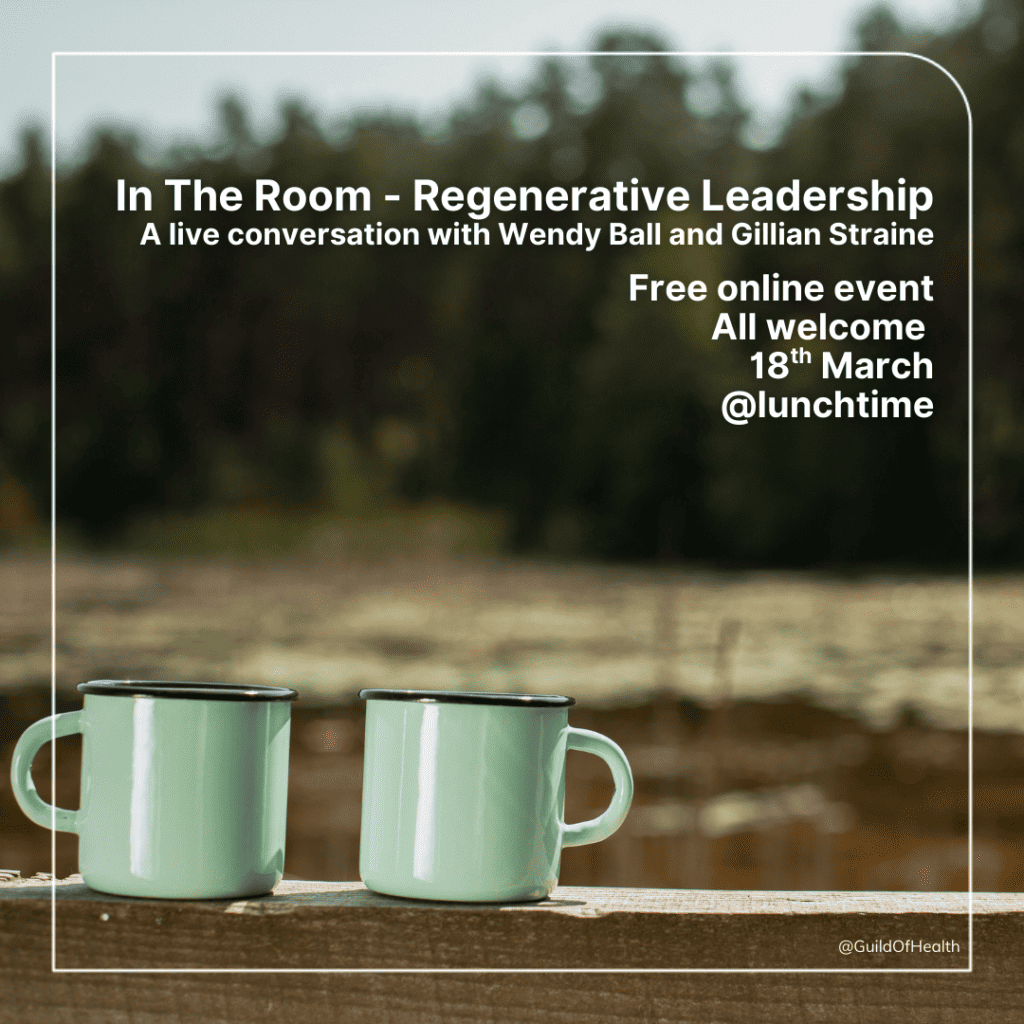
In the Room – Regenerative Leadership
“In the Room” is our free open conversation series — a space where anyone can join, listen, question, and contribute. Whether you’ve engaged with our courses, listened to the podcast, or are simply curious about a topic, you are welcome.
In this session, Wendy Ball and Gillian Straine return to their recent GoHealth Podcast conversation on regenerative leadership and open it up to you.