

Biography
Rt Revd Adrian Newman
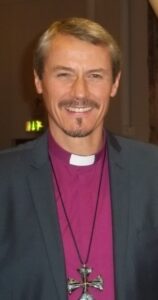
Adrian Newman worked as a management economist before ministerial training at Trinity College Bristol. He was ordained in 1985 and served as a curate at St Mark’s Forest Gate. In 1989 he was appointed Vicar of Christ Church, Hillsborough, Sheffield.
In 1996, he became Rector of St Martin in the Bull Ring, Birmingham, and oversaw a redevelopment of the church site at the same time as its parish was being transformed by the demolition and rebuilding of the surrounding retail district.
He became Dean of Rochester in 2005, leading the second oldest cathedral foundation in the UK through a time of cultural change and major redevelopment.
He became the Bishop of Stepney in July 2011, serving one of the most exciting, vibrant and diverse places in the whole of the country, an area that is challenged and challenging, but authentic and alive.
At the end of 2018 he resigned his role on health grounds, to see if some time out of ministry would help with chronic migraines and a period of mental ill-health. He took early retirement in 2020 and now pursues a number of pro bono commitments to church and society, which he manages around his continuing health issues.
He is married to Gill, and they have three adult sons and a young granddaughter.
Episode notes
What is the meaning of health? Bishop Adrian Newman talks with Dr Gillian Straine about the answer to this question, as well as sharing his story about retiring from his role as Bishop due to chronic migraines.
There is so much to ponder from this episode we’ll be taking a break in August but will return with our new podcast series in September.
Ponder along with Gillian and Adrian:
- The traumatic events that Adrian experienced in his formative years that led him to engage with church as a place to consider the questions of life.
- How a statistical economist became an ordained clergy person.
- The pyjama and corridor encounters that make a Bishop.
- Why Adrian chose the Canterbury Cross as the emblem for his time as Bishop.
- The experience of chronic migraines and mental ill health that led to Adrian’s resignation.
- Vocation and retirement – decomposing and rewilding.
- Avoiding introspection in times of ill health.
- The true meaning of health.
- Why the stone of the tomb was rolled away.
Links
Wilderness and wellbeing retreat – book now!
Join the GoHealth community.
Find us and follow us on all the socials @GuildofHealth
Transcript
Gillian Straine: I am Gillian Straine and welcome to the GoHealth podcast.
So we are in season two of the podcast where we are exploring, learning to heal. And it’s called Clever Double Meaning. In this podcast, we are exploring how by listening to the stories and experiences of others, we might learn to heal ourselves, or we might be learning to be a source of healing for others. And we’re in the final episode of the season.
I can’t believe it, but we are going out on a really high note with this next guest, the very Reverend Adrian Newman. Bishop Newman worked as a management economist before ministerial training in Bristol. He was ordained in 1985. He then served a curacy at St Mark’s Forest Gate and then went on to be a vicar in Sheffield. In ’96, he became the rector of St Martin in the Bull Ring in Birmingham. That’s the church right in the middle of a shopping centre now. But he was there when it was getting built. He oversaw the redevelopment of the church site and the whole parish was being demolished and rebuilt all around it. He then became dean of Rochester Cathedral in 2005 before being consecrated as the Bishop of Stepney in London in July 2011.
At the end of 2018, he resigned his role on health grounds to see if taking some time out of ministry would help with chronic migraines and a period of mental ill health. And he then took early retirement in 2020. So I was working in the Diocese of London when I heard about this highly successful, highly talented bishop stepping back from a high profile ministry and very openly talking about his health struggles.
And I just knew that he was someone who we at GoHealth could learn from. I knew he’d have an interesting story and I wasn’t wrong. It was a great privilege to talk to Bishop Adrian about his life, about his health struggles, and about how he lives and works and is today. The conversation was, you know it was remarkably open and engaging. And really for us listening to this episode, it’s a wonderfully wise closing act of season two on the GoHealth podcast, so please enjoy it and let us know what you think – pop over to the GoHealth Community Facebook group.Bishop Newman (referred to as Adrian throughout the episode): It’s great to be here.
Gillian: Thanks so much. So how are you today? Where are you sitting? How’s your day going?
Adrian: Well, I’m sitting in a tiny little cottage in the wilds of the Essex countryside. It’s a bit cloudy outside, a bit windy and am, yeah but having a good day.
Gillian: Good, and you know, we have been wanting to invite you on our podcast since, since it began, because you were in the headlines for stepping down from a senior role in the Church of England because of a health condition. And we run a charity all about health and faith, so we just knew we wanted to chat to you, to learn from your experience. Before we get there it would be great to hear a bit about your story, sort of pre-early retirement, how you came to be ordained in the Church of England, where your sense of vocation came from, and a little bit about your life before you got to that point.
Adrian: So none of my early life was spent in or around the life of the church. It was all very new to me, and I suppose I had a classic Christian conversion in some ways. I at the age of 12 or 13, I witnessed two fatal car crashes in quick succession, and one of which I actually the two people bled to death in front of my eyes and I was powerless to do anything to help. I was the first person on the scene and those two quite traumatic experiences had quite an impact upon me and I think led me even at that tender age, to ask lots of questions about life. I’m the youngest of six children and my next sister up at the time had just started going to a local church, I think because there was a rather good looking Californian bloke who was there. But, but you know, she was, she was that sort of awkward age for girls, sort of 14, 15 and I thought she, she changed for the better, I saw that positive change in her. And so I went along and I just sat at the back of this church for about a year listening to what they were saying. And, and at the end of that year, I think I was convinced that there was something in it. And I vividly remember one Sunday evening in church, the vicar gave the classic altar call from the front of the church, and it’s quite a packed church, about four or 500 people in the church at the time. And so he asked people to come up to the front if they wanted to commit their life to Christ. And I, along with an ancient man who was probably only about my age, to be honest, but seemed like an ancient man at the time and a member of the choir. The three of us went to the front, and that was the point of which I think I, I can trace my first sort of steps of positively calling myself a Christian to that.
Gillian: What a thing to witness, I guess, at that age. And, you know, I wonder, do you think that’s something that that you’ve processed or I guess I wonder if other people listening to this podcast might have had similar experiences. Can you say something about how how you’ve processed that and in some ways then reconciled that with this next experience you have of meeting a church community and learning about a God that loves you and presumably loved that person who bled to death.
Adrian: Yes, well I suppose it’s a lifetime of processing something like that, although I think every experience gets caught up into the further experiences, doesn’t it. Undoubtedly was a shocking thing to go through at that age. I was very young at the time, but I think it’s probably simply exposed the fact that I, even from a young age, had thought quite deeply about life and felt that there had to be some answers around to the mystery of human existence. And that may sound too grand a thing to be saying when you’re 12 or 13 years old, but I do think that even at the young age I think people can feel that. And I was certainly somebody who was asking all sorts of quite deep questions from when I was young. Processing it – I guess one of the things that life teaches you is that pain and suffering and death and loss are part of the fabric of life. And if we’re going to have a philosophy, we’re going to have a theology, which takes life seriously then it has to be capable of coping with the difficult and the dark elements of our lives as well as, you know, when everything’s plain sailing.
Gillian: Yeah, we’re going to get there. But yeah, absolutely. But you know we’ve only got to age 14.
[LAUGHTER]
Gillian: And so you joined the church at that point. You gave your life to Christ or whatever language you want to use around that. So into vocation and training? What was that like?
Adrian: From that point, I started going along to a church and when I left school, I left school at the age of 17, I went to then work for a year in a hostel for homeless men in Leicester, and that again was a very profound eye opening experience. Here was this rather closeted, protected, middle class lad with a nice sort of education and a middle class family. And I went into a type of context which was foreign to me and not one that I knew at all. And I experienced things there, which again were foreign to me and different and other, and helped me understand that it’s a very, very big and complex and confusing world that we live in. And then after that year, I went to I went to university down in Bristol, studied economics.
My dad was a businessman, he ran his own business, he was in life insurance, and I think he had been hoping and I think I had rather been expecting I would simply follow in his footsteps and probably take over the family business at some stage. So I did an economics degree and at the end of that I went to work in the industry as a statistical economist for a couple of years. And it was during that period when people within the church started saying to me, ‘you should think about ordination’. And I was only in my early mid-twenties. I was far too young really and so I sort of laughed in their face and said, well, I’ll go and see that DDL or whoever it is you have to go and see. But I’m sure they’ll say to me, come back in a few years time when you’ve got a bit more experience under your belt. But actually the door swung open in front of me with some alacrity, so I found myself training for ministry down in Bristol at the age of 23, 24 or something like that, it was really quite young.
Gillian: Statistical economist.
Adrian: Yes.
Gillian: So as you know, I’m a physicist and people who don’t know much about science or the church will say to me, ‘How could you be a physicist and a priest – aren’t they in opposition?’ And then I roll my eyes inwardly, I would never do it outwardly and then I explain why they, you know, they got together so nicely. But I feel I need to ask this question, mostly because I’m scared of economics, but is there any any crossover in your early life, in your training, that’s useful for being a priest or somebody who is qualified to speak about God in some ways? Is there any sort of crossover there? I’m curious.
Adrian: Well, there were undoubtedly things about my economics and business training, which proved immensely useful as I move through different ministry roles. Undoubtedly, those experiences of economics and business were helpful, but I think, there’s always the other way…anybody whose had any experience out there in the real world, another phrase that I don’t particularly like, anybody who’s had any experience of working alongside people in, in a, in a classic working environment has got to begin to work how and where God relates to people and people can relate to God in that ordinary and everyday setting.
We’ve got rather good at just sort of closeting God out into the church somewhere and that can all be rather comfy and easy. Whereas actually it’s, it’s the world in which God is and we have to understand where we discern him at work there.
Gillian: I couldn’t agree more. Okay, so after ordination, you’ve served in quite a few… you’ve very good parish experience…before being a bishop. How useful that must be.
Adrian: Well, I mean, I suppose I’m, I’m one of those who believes classically that anybody who moves into senior leadership in the church should, as far as possible, do that via the parish route, because I think that’s where you, you really do see the church at a grassroots level. I mean, I was immensely grateful for the parishes that I served in, started off in the east end of London as a curate in Forestgate, and that was that was a fabulous place to be. And then I went up to Sheffield to an outer city, very different. So London, east London in the mid-eighties was highly cosmopolitan, incredibly multicultural. I went up to work in a white working class estate in Sheffield, which again was very different. And of course those white working class estates are now very much in the news at the moment because they are the sorts of places where the church has been probably at its worst in terms of its visibility and presence and ability to, to serve.
So and then from there, I went down to be rector of a city centre church, St. Martin in the Bullring. I mean, I’ll always look back to my experience there as, when I’m when I’m working in my rocking chair, I think that will probably be among the highlights of my life. I think working with a fabulous group of people to an extraordinary timetable to try and transform and turn around the church, which was at the centre of the largest building site in Europe at the time. And, and yeah, so that was a great experience. And again, broadened my understanding of God and the world in so many ways.
And then I woke up one morning, one Saturday morning day off, came downstairs in my pyjamas and there was a letter from Tony Blair on the doorstep saying ‘I’ve thought very carefully and I would like to be the next dean of Rochester’. I thought, oh yes, I’m sure that’s how it works.
[LAUGHTER]
And I had been a great critic of cathedrals as a parish priest – you know, sort of distant and not properly engaged with, with real life, it was slightly elitist and I went to Rochester Cathedral and was blown away by the way in which God was at work in a place like a cathedral. But that sort of broadened, broadened me out, certainly in terms of my ecclesiology, in terms of my tradition. It was a liberal Catholic setting, and I came to value the sacraments and mystery hugely from my time in, in Rochester. And then Richard Chartres, when I knew through the church commissioners, as I was serving as a church commissioner at the time, he stopped me in church house one day and said, Adrian, could I persuade you to think about coming to London to Stepney. And that’s how I ended up as the bishop of a Stepney, almost back to my east end roots, from my curacy.
Gillian: Yeah. Well, you, you paint a great picture, a letter from Tony Blair in your pyjamas. Bishop London in a corridor. That’s how it really works.
Adrian: Yeah, it doesn’t these days.
[LAUGHTER]
Gillian: So before we get on to you being a Bishop, we, we have a quite high number of clergy who listen to this podcast. We run a project called the Healthy Healing Hub project, which helps churches and indeed cathedrals. We’ve just had our first cathedral, in fact, be hubs for healing for the whole community. So promoting the healing ministry and you know, it’s not rocket science is straight back to what Jesus said, make disciples and heal. So helping people do that with confidence in their context.
But a lot of my time I spent speaking to really rather fed up, sometimes quite depressed, certainly disillusioned clergy, parish clergy who are on the ground. I know the church context has changed a wee bitty since you were engaged with parish ministry and cathedral ministry and things, but I wonder if you could offer some stories or insights about what helps when it’s really tough. I know lots of people are on their knees at the moment, actually, with, with doing parish ministry as we come out of the pandemic. And we all know how tough it’s been. So looking back, are there things you might want to pick up or highlight any clergy or indeed lay leaders who are listening.
Adrian: I suppose, what, what can I say to that? T’was ever thus – is probably the last thing that people might want to hear. But I was interviewing some potential ordinands for the Diocese of Chelmsford recently, and I asked them a question at the end of this interview, which I was asked when I was being seen by the Bishop of Barking back in the early 1980s. And he said to me, things are pretty bad at the moment, are you optimistic for the future of the Church of England? And I asked the same question of people who were wanting to come into the church. And I suppose the point there is that’s 40 years ago I was asked that question and the Bishop of Barking at the time thought that it was pretty bad and pretty demoralising. And that circumstances around us were difficult. So t’was ever thus, is is an element of the answer to this, that there are always difficult and challenging circumstances to face in the life of the church. We have to believe in the power of vocation and in the presence of God within this and not to get too hung up on some of the very difficult human dimensions to all of this.
I suppose what helps? One of the things that I had to really hold on to carefully and consistently after my own illness caused me to step back, was to understand my illness as a gift and to resist becoming a victim. I mean, I was influenced by people like Edith Eger, the great sort of Jewish writer who had refused, despite being a Holocaust survivor to define herself as a victim and has gone on as a psychologist to explain how important it is not to victimise ourselves. Though I suppose there is something in all of this about how we retain our spiritual equilibrium in the face of enormous external challenges. How do you retain a balanced interior, spiritual core to all of this?
Gillian: That’s what we’re all wanting, that kind of balance as Christians. keep that balance, you know, as we progress through life. So let’s go back on the on the chronology. It’d be really good to hear a little bit about what it was like to be a bishop in the church of England, the challenges of that, and then maybe talk about your illness and when you first started noticing it and having an impact on your work.
Adrian: Yeah, well, I mean, being a Bishop in the Church of England. I do think is a very challenging time for anybody to be a serving bishop in the in the Church of England. There are lots of external challenges, but there is also huge expectation in terms of what you are able to achieve and people will project all manner of unrealistic expectations. So when when I was consecrated on the eve of your consecration as a bishop, you get an hour and a half with the Archbishop of Canterbury and Rowan Williams was the Archbishop when I was consecrated. I asked him In the course of this hour and a half, I said, what advice would you give me for when I become Bishop? I’d been a dean, so I’ve been in senior leadership, I sort of understood some of the dynamics, but I still wanted to know what his advice would be about being a Bishop. And he leaned back in his chair and he came out with something which was ever old and ever young, in some ways, he said, ‘When you become a Bishop, you will be praised for all manner of things you deserve no praise for.
And you will be blamed for all manner of things you deserve, no blame for. You have to learn to treat those two imposters both the same.’
And so, you know, you can be seduced by the position of being a Bishop, there’s no doubt about that. You have to resist being seduced by it, seduced by the way in which people can say things about you which are wholly unrealistic, you know, positive things about you, which are wholly unrealistic and don’t reflect who you are at all. But you also need to resist being completely demoralised by the criticism that you receive. That’s not to say that we shouldn’t be willing and able to accept responsibility where we have made mistakes for our failures, for our shortcomings, for our vulnerabilities in what we do. But you have to be realistic. And this goes for all leadership, actually, not just the leadership of a Bishop or anybody in leadership, any clergy person. I would often say this when you have a dog collar wrapped around your neck and people will project on to you all sorts of unrealistic expectations, vast majority of which may well come from their own internal insecurities rather than your actions. I think that’s an important perspective to hold on to and to remember. Find a way forward which has integrity and is authentic within that, between those two poles, is quite important.
Gillian: So you took early retirement for ill health, can you tell us a bit about that journey.
Adrian: Yes, I mean I had…most people look at me and think he looks as healthy as anybody in the Church of England, I’ve got one of those faces…
Gillian: That’s not a great comparison to be fair…
[LAUGHTER]
Adrian: But I mean, I’d suffered through migraines for about 15 years. They were getting progressively worse to the extent that by about 2017 I was getting a 48 hour migraine every 8 to 10 days and it was pretty debilitating to experience it. But my mum and dad, my dad fought in the war, my mum was a nurse in the Blitz and they were of the generation that brought their children up to say, you’ll cope, you can cope. And I did, I coped with this, I worked through it, I didn’t let it stop me working in any way, but I was finding it increasingly difficult to cope with it. And by the time I got…that was about five years ago now….members of my family were saying to me, you need to stop actually, you can’t go on killing yourself like this. I was under the National Migraine Clinic, so it’s getting, I was on a drugs treatment. I had my drugs changed, so I suppose this was the thing I always look back to at the start of 2017, I had my medication changed and for around about four or five months I thought they had found the miracle cure that I had been hoping and looking for, the years leading up to it. I found that if I could sense a migraine coming on and I hit it with high doses of this medication, it would ease it off rather than it coming on and being totally debilitating. So for those few months, I was on cloud nine thinking that this was going to sort out my migraines and allow me to be able to live with them much more easily.
And in the middle of that year, 2017, for the first time in my life, I started to experience mental ill health. So, you know, everybody goes through ups and downs and I don’t like to use the word depression. And I found it very hard to even attach the word depression to what I experienced because of that. But it became clear to me over the ensuing six months that I was in the grip of a quite significant deep depression and acute anxiety.
And I put it down to the fact, I’d been asked by the Archbishop of Canterbury to chair this National Commission on Cathedrals, and it was a bit of a poisoned chalice of a job if I’m honest. And you know, you knew that you would never get a get it right for everybody. And I put it down to the fact that there was quite a lot of stress associated with that piece of work. But I got to the turn of the year, and it was one of my sons, actually my youngest son who’d done a psychology degree some years earlier said to me, ‘Dad, have you ever considered that it might be your migraine medication which is making you mentally unwell?’ And it just hadn’t occurred to me and I look back now and I feel ridiculous.
I know enough about these things to know that changes in medication can have an impact on mental health. But it just had not occurred to me, and so there I was probably the best place for my migraines for some time, but feeling in an absolutely awful place in terms of my mind. So to cut a long story short, I took myself…I discovered that the medication could, in about one in three situations, cause mental ill health, cause depression and acute anxiety. So I took myself off that medication straight away, and over the course of the next six months, I reached a much better place in terms of my mental health, and I think that was the cause of this. But my migraines came back with an absolute vengeance and were deeper and more intense than they had ever been like. I said then and I’ll say again now I’d rather have a migraine than that depression and acute anxiety because I felt like I was standing on the edge of an abyss and about to fall into it. And, and it was an awful place to be in. It gave me a great insight into what people experience when they are mentally unwell. And so in some ways that’s a good thing that I had that insight. I don’t think I’d really fully appreciated just how awful it could be to be in that place. I got to the point where I felt the only thing I hadn’t attempted to do in any of this was to step back and see if part of the reason, part of the cause of my migraines was the fact that I was working in a very intense environment and doing a quite intense role in the life of the church.
My intention was, I just turning 60 at a time and I wasn’t intending to retire or stop. I just thought, well, I know I’ll have to resign as Bishop because what I probably need is a year out just to see what that does to me. So that’s what I intended to do, as it transpired, the migraines have carried on pretty much as they were before, so there’s purely..it is clearly something physiological and it’s not just to do with the stress of the job that I was doing. So I now know that I simply have to live with these things.
Gillian: And you chat about it in a very straightforward way. I mean, that decision to stand down, to be public about your frailty, you know, in your physical frailty, having the headaches and stuff, that that must have been that must be a tough decision. Did you get backlash?Were people of angry at you for stepping down or people generally supportive?How did you reconcile yourself to it?
Adrian: I think if people were angry, they didn’t tell me. The people who told me were people who were supportive and felt that it had freed them up to be honest about what they were experiencing. A couple of clergy said to me, ‘I have not even felt able to acknowledge to myself that I’m mentally unwell, but I am able to do that now.’
Gillian: Wow. So you modelled something.
Adrian: I think there was a certain liberation for some people to feel they did not have to conform to this all conquering hero in the clergy. And I suppose I’ve always tried throughout ministry I think to, to model an appropriate vulnerability and that sounds makes it sounds as if it’s just an intentional thing to do it and not something authentic. What I mean by that is I’ve tried to be authentic to who I am and who I am is certainly not some sort of superhero. It’s…I’m a very flawed human being. And I think to try and make that is obvious without overplaying it in terms of a situation I’ve been in, to be honest about my own faults and failings and vulnerabilities and insecurities.
And I think is part of what the job of ministry is, actually, to some degree, it felt like an extension of where I’d been. Having said that, and I have said this to somebody just yesterday, I do think is probably the bravest thing I’ve done in my life. And I don’t I don’t say that to trumpet it. But, you know, there was an element of courage I had to summon up.
Gillian: Oh, absolutely. I’m so glad you said that, because I think you’re you’re I mean, that’s I’d love…I want to know more about that. You released other people to be okay with their vulnerability, because I remember seeing it in the newspaper, Adrian, I didn’t know you really well, but the thought of you, obviously quite a young person and you had this, I thought, well, this is this is a really good moment for the church. It’s somebody is putting their physical and mental health before ministry, I think it must be a hugely brave decision to do as well.
Adrian: In some ways what you’re admitting by saying your thinking is courageous is it’s not something very good, is it? Because it’s elements of identity and meaning and purpose which are caught up in any role that you do. And by stepping back from that role, particularly when it has an element of hierarchy and symbolic status to it, there’s a letting go of that. It’s quite possible that you could disintegrate in terms of your identity when when you’ve had such a strong, strongly bound up identity with your role. And I think that’s the thing that took a bit of courage, was saying, actually, I will not collapse. I will be me, the human, baptised, Christian, Adrian is going to survive this and and just because my role is taken away perhaps actually it will be a good thing, because it will expose who I am to myself and perhaps to others in a way which would not have happened if I’d stayed in role.
I’ve long been drawn by the Irenaean vision of the glory of God being a human being fully alive. And I think to be fully alive you have to embrace all that life and being human is about, don’t you, the bad and difficult, challenging things, as well as that good and glorious bits of it.
Gillian: And some people write and say it’s actually the tough the tough bits that make us more aware of the glory of life rather than less aware. I think sometimes that’s easy in retrospect. I think sometimes when people are ill, there’s a pressure, especially as a Christian, to to think, oh, it’s all fine, I love Jesus, everything’s okay. And they’ll be honest about the experience. But, you know, with the with a healthy honesty about how difficult it can be, you know, that that Irenaean vision is very powerful. And even when we’re dying perhaps as well, that’s the kind of that’s the goal, isn’t it, to have that peace on a final journey.
Adrian: When you become a bishop, you have to get all sorts of bits of kit, some of which I think I hadn’t even got a clue what they were, I just, I don’t mind admitting it. You know what’s a rochet? What’s a…I’ve never heard of these…
But one of the bits of kit you have to get is a pectoral cross. And a lot of bishops use that as a way of trying to identify themselves and to others the nature of the type of ministry they want to have. So I deliberately chose, almost as an emblem for me, was I put it on my pectoral cross it, put it on my, my ring and I put it on my miter as well. The Canterbury Cross, which you may or may not know, is it’s a circular cross. It was named after a cross which was discovered in a field in Canterbury in the ninth century or something. But it’s circular, but it’s eight segmented Canterbury Cross and the number eight is is pretty crucial in scriptural terms and particularly the Book of Revelation. So it’s the perfect number seven plus one. And so in the number eight came to be known as the as the number of resurrection. So it was the seventh day plus one. And therefore this eight segmented cross, the Canterbury Cross is clearly a cross and it holds within it the cross which Christ died. It embraces pain and suffering and death, but it also speaks of resurrection. And I’ve always found that a very moving idea, that the idea that in every little death and every big death that we experience, there are the seeds of resurrection, if we can only find them, if we can only look for them, if we can only excavate them from that experience. And so I think there’s something about realistically working our way through the hardest things in life, but looking for the empty tomb, looking for the point of resurrection, looking for the way in which this can lead to renewal and new life. And something positive and hopeful for the future as well.
Gillian: And thinking about your own life and your call, your vocation to ministry, which led your position in the church with a miter and the pectoral cross. I’m sure non anglo-Catholics are now looking that up, you know, how do you think vocation now, you’ve retired and I know you do a host of other things well, but tell me more about that.
Adrian: I’m still trying to work out what vocation means in retirement, if I’m really, if I’m really honest. It’s fascinating actually – you reach this point and well, I have discovered there’s hardly anything written about vocation in retirement or even about retirement in general, other than the practical stuff about what you do about housing and money and all of that. And how do you go about getting a license from the Bishop where you are now?
So so I’ve done quite a bit of thinking about this myself over the past few years, and I suppose the two words I have been playing around with in my mind that I think have got quite a lot to them. One is decomposing and the other is rewilding.
The decomposition bit, until we moved here, I’ve never lived in the country in my life and we don’t have a garden where we live. We, we, we have no land around this little cottage. And on the eve of lockdown, we managed to acquire half an allotment in the neighbouring village. And so I’ve been learning quite a lot about the land and gardening and horticulture and stuff like that over the past few years. And one of the things that has fascinated me is the, is the idea of compost. And this will be very familiar to lots of people, it wasn’t familiar to me. The idea that you can take things which are ostensibly dead or worthless or have been cut off and you put them onto this compost heap and you leave them. And what happens is it turns into this fecund, fertile place, which gives an extraordinary amount of life back to the land. And so that idea of decomposition, I think, is quite an interesting one to somebody in retirement. Physically, of course, we’re at an age where we are the decomposing, but actually having spent a lifetime in ministry of composing, being a, you know, the one who composes things and make things happen, suddenly I find that my life is really one of decomposition now.
And rather than that being solely bad and difficult and diminishing thing, actually to look for what there is in that can be fecund and fertile and lead to new life and new opportunities. So that’s one concept that I think that wanting to continue to think about the vocation of decomposition, what does what does a vocation to decompose look like when you move from active ministry into retirement and alongside that the whole question of rewilding which as you well know, is a very significant feature of our environmental landscape at the moment. But again, this idea that once you stop controlling an environment, something new can emerge, which is unexpected, wholly unexpected, and can be far more life giving than what was there before. And I think there’s undoubtedly an element of what I’m trying to do at the moment, which is to stop being in control of my life and stop managing it and just see what happens when I allow a little bit of wild growth, because something unexpected may spring up which I have not seen before, and which might surprise me and delight me.
Gillian:
Well, Adrian, it sounds like you need to write that book. I mean, I say quickly before we release, the podcast.Those are really powerful images. What you describe there sounds like a deeply healing journey. Rethinking your vacation in terms of decomposition and rewilding sounds like a way of healing.
Adrian: It is work in progress. I’m far from saying I’m there or that I’ve understood where this is going, but that’s part of the excitement and the adventure of it actually. I don’t quite know where it is going to go.
Gillian: Has your views about health changed? What role has your faith played in your healing journey? You know, you’re a man of God. You stand up and tell everyone that we can be reconciled to God through faith in Jesus Christ. There is a particular healing ministry in the church, and yet you haven’t been healed, in inverted commas. You still get the headaches. How do you sew all that together?
Adrian: With difficulty. I don’t think that’s an easy thing to sew together. But I guess throughout the whole of the ministry that I’ve pursued, the question of what healing is has always been there. What does healing mean for an individual, particularly somebody who doesn’t appear to be physically healed? And what does that mean? Can somebody still be healed and experience healing even if they don’t experience that healing in the way that they hope they might?
But also, the healing of society, I mean that some sort of collective understanding of this as well. What does it mean for society to be that healthy is…and of course those two things are intimately related. It’s pretty obvious. I mean, when you think of ill health as being pain, a limitation of some description, but I suppose when I think of ill health and in my own experience the thing that I am aware – the thing that is most difficult is a form of introspection.
Ill health turns you in on yourself. It narrows life down the walls start moving towards you horribly when you’re unwell. And that’s the nature of it. As something highly introspective, a narrowing life around you can be one of the most difficult aspects of ill health, and I don’t think you can escape. The first things I had listed there the pain and the limitation and the anguish I think they unless you are fortunate enough to have a very obvious physical healing, I don’t think you can escape those things, but you can, it seems to me, do an awful lot about the introspection.
And I suppose in my mind I think of health as sort of heads up living, as living, looking outwards, continuing to look outwards, even if you are in pain, even if you experience limitations because ill health… retaining the ability to look up an outwards to God and to neighbour, that I think is probably how I would understand good healthy these days.
Gillian: That’s so powerful, because it’s talking there about connection, isn’t it? Still connected to the world, still connected and still seeking, if your head’s up you’re seeking, aren’t you? And there’s such pressure, I’m sure it’s always been like this in some ways, but the pressure today, when you think, when you say health, you think of that magazine rack, don’t you? Or I do anyway, I don’t know if you buy magazines for, you know, it’s all about perfection, about eating well, which actually implies some kind of economic ability to do so and perfect bodies and beauty. And it’s actually about pressure to perform in some way or to be seen as in some way. Whereas I think what you’ve described is, is how to live and how to work out who you are.
Adrian: It struck me when you were speaking that two things which you might associate with health are things that I do, I do a lot of. So I’ve moved to a plant based diet over the past few years, and I do an awful lot of exercise on my bike around the flatlands and hills of Essex. But I did not even think of those things when you asked me to think about health, whereas both of those things could be understood as being the things that make us healthy – eat a good diet, take lots of exercise. I suppose it’s because I feel that health is something much more profound than that. Those things are maybe part of it and they might help you to have a healthy outlook. But it’s, it’s something deeper than that, it seems to me.
Gillian: Yeah. Yeah. There’s an amazing quotation, it’s Moltmann I think, he defines health as the power to live and the power to die, which I just think, oh, that’s just that’s it. Because the problem with the magazine rack and there’s nothing wrong with plant based diet or any exercise, of course, is that the health industry never mentions death. And the medical system is, you know, largely based on avoiding it at all costs. So it’s like this massive elephant in the room. Any time most people talk about health and it’s the massive elephant that the church and the faith in Jesus Christ can address.
Adrian: It’s back to the Cantebury Cross – it’s the death and resurrection being held together. Needing to be able to cope with both of those. I do do a little bit of leading of services and preaching still when I’m asked to around here and I was asked to do Easter and this year and I was preaching on the stone rolled away from the tomb and making the point why was the stone rolled away from the tomb? There was absolutely no reason from Jesus point of view for it to be rolled away from the tomb. It is pretty clear that after his resurrection, he can move through walls and doors and, you know, tele transport across all sorts of distances. So he didn’t need the stone to be moved to get out of the tomb. And so it must have been moved for our benefit, for us to look in, because we are being called to look in and to realise that the tomb is empty and then to go out and live the rest of our lives in that full recognition that we live as people of resurrection in a world where resurrection is a reality. And so I think there is something very significant about that in terms of how we think about our lives.
Gillian: Yeah. I’ve never thought about why the stone was rolled away. So you’ve just written my next Easter Sermon, and everyone listening, brilliant! I never thought about it. That’s what’s so wonderful about the Gospels – you can go back and see something new every single time. And so I just think it’s such an important message for what people are going through today. We’re facing vast social trauma which has shaken the foundations of so much we sort of take for granted as a society and exposed so many wounds of injustice and so on, that never has this message of the…of needing to spot the glimmer of the resurrection in life more important.
When it’s tough, Adrian, when you’re, you know, maybe when the headaches are back or when you’re having a tough time in terms of the faith, what helps, what is…And I’m asking the question, you know, for anyone who’s listening, who is struggling to see that glimmer of the resurrection today.
Adrian: I think sometimes it’s having some markers when your journey that…to hold on to and I do think a commitment to things like asking where is the gift in this? We are all going to experience all manner of challenging issues in life, it might be physical illness, it might be something very, very different, it might be the breakdown of a relationship, whatever it might be, and to to hold as a sort of spiritual marker that you are always going to ask that question, of God and deeply of yourself – where is the gift in this? What gift am I being given in this, is a way of lifting, you know, that heads up living that I think health is about. Trying to look away from the interior journey as the soul defining pilgrimage that you are going through and to, to try and discover a gift is important. And when we…when we think about contemplating the empty tomb, I think that’s again, one of the things that we’re that we’re doing, is we’re saying where is the resurrection in this death? So I think asking those questions and almost laying those down, whatever I go through I am going to do this. I mean, how do people do that practically? For me, I will often walk and ask those questions of myself. Other people may find it easier to sit inside and do that and to, to sort of kneel down and and pray in their sacred place. But for me, I find it easier to sit on the saddle of my bike or to get my walking boots on and to go out and to ask those questions. Having important people around you, people who can share the journey, I mean, that’s one of the things I think we all would say that, to have one or two people like that, you can be soul friends to you when the going is difficult and when you’re finding it difficult to get perspective, it’s so important to have people who can help you think it through, can help talk it through or who can simply sit with you and just acknowledge the fact that it’s tough, that that’s the problem shared stuff, isn’t it? Whether it becomes a problem halved, I don’t know, but I think a problem that shared certainly becomes a lighter burden to carry.
And sometimes I think it’s, it’s the discipline stuff, isn’t it? Keep on doing the right things, keep on doing the right things. Whether that’s prayer and worship, whether it’s doing the things that you know are good for you, it’s very easy now, I know we talked about some of eating healthy and exercising, if you start to live introspectively and find the walls of life closing in around you, the first thing that happens is you start to eat badly and then you start not to move anywhere. And both of those things have a profound impact on our minds. They make us think badly and our minds are the powerful element to our existence. And we have to be as careful as we can about feeding them well and looking after our minds to try and avoid them making an already tough situation even tougher.
Gillian: Aw thank you, that’s so wise as well, because we are a mind, body, spirit. We are, science has proved it, so does the Hebrew Bible by the way. It’s so important to look after our bodies and minds and there’s something really healing about being outdoors. I was in a very tough time the other week and I realised I’d been inside or during the children’s school run for days, and I just I just went outside and I felt better. I just did not need a roof over my head, it’s really weird.
Bishop Adrian Newman, thank you so much. Talking about gift, it’s been a gift to talk with you. Thank you so much for sharing your experience, the good bits and the bad bits, of leadership, of living with ill health. Thank you so much for modelling something really profound about looking up, about health when things aren’t always so rosy.
Adrian: Thank you, I’ve enjoyed having the chat and thank you for all that you’re doing with your work and with particularly with these hubs, which I think will be a real gift to the church.
Gillian: Thank you so much.
So that was my conversation with Bishop Adrian. Thank you so much for listening. What did you think? You know, it was wonderful to just spend time with Adrian. I felt like he had something I needed. In his decision to leave the church, his honesty about his mental health struggle, his ongoing living with pain at such regular intervals and with some really embodied spiritual wisdom for us all, there, we’d love to know what you thought of the podcast.
The podcast is freely available to all, but we pick up the conversation in the GoHealth community. If you’re not already a member, join us, it’s only £4 a month. You get resource bundles, you get discounts, you get free events, you get free training. All sorts of things going on in the GoHealth community. Our tagline is wonderful, it is together we flourish, together we flourish.
And that’s what we try to do through resources, events, conversations. Together we flourish for our good, and for the good of the communities we live in, in the name of God. And we’re right now…I’m so excited…we are booking for our first ever GoHealth community gathering, a retreat in the Lake District in the north of England, where we can keep the conversation going, keep working out how to flourish together. Let’s chat, let’s engage, let’s connect with one another over meals, over walks and campfires – I’m very excited about the campfires. It’s called the wilderness and wellbeing retreat. It’s a two night retreat and we are focusing on the healing power of where we are, the lake district, the beauty of nature, and use it to explore the Christian faith and to reflect on our spiritual journey. And we have booked two fantastic leaders, specialists in mountain spirituality, in walking and pilgrimage. It’s taking place on the 16th to the 18th of September. Head over to the website for more details or check out the episode notes to find out more.
Please rate and subscribe. Hit the subscribe button right. Why those shared on your social media is to you. We want as many people as possible to experience these conversations and to connect into our work. That will be amazing. So in the meantime, and for the last time in season two, God bless you. Let’s keep connecting and chatting. Let’s keep learning to heal because together we flourish.