

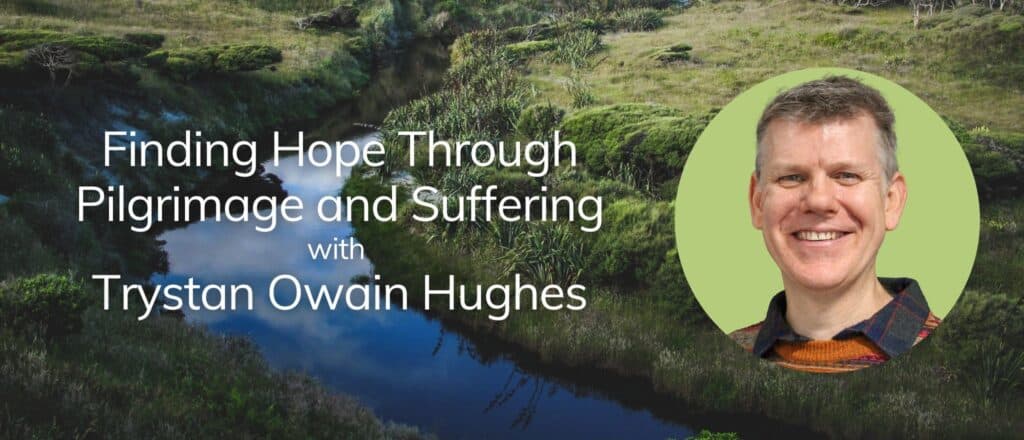
In this deeply moving conversation, Trystan Owain Hughes shares his journey of undertaking a 140-mile pilgrimage across North Wales while living with chronic pain, and the unexpected second pilgrimage that followed when his back injury worsened dramatically. Drawing from his latest book “To Hell’s Mouth and Back: Pilgrimage, Suffering, and Hope,” Trystan explores how vulnerability in leadership, finding meaning in suffering, and noticing “God winks” in everyday moments can transform our understanding of healing and hope.
“I think at the heart of pilgrimage is a tension between suffering and hope.”
trystan owain hughes
In this episode:
Key Topics Discussed
The Physical Pilgrimage
- The Pilgrim’s Way: 140 miles across North Wales to Bardsey Island (Ynys Enlli)
- Undertaken eight years after major back surgery (titanium bolt between vertebrae)
- Challenges included knee injury, getting lost, bad weather, and ongoing chronic pain
- Five elements that define pilgrimage: suffering, wonder of nature, friendship, dependence on God and others, and signs from God
The Second Pilgrimage: Recovery
- Extreme back pain returned the day after completing the walk
- Spent a month largely confined to a red sofa
- Explores the “pilgrimage mindset” – finding the same sources of hope whether on a 140-mile walk or a 30-yard walk to a lake
- Viktor Frankl’s insight: suffering expands to fill whatever space we’re in, regardless of size
Goldfinch Moments: Noticing God’s Presence
- The goldfinch as a traditional Christian symbol of healing
- “God winks” – moments when God prompts, directs, or comforts us
- Carl Jung on synchronicity: “People don’t see God in their lives because they don’t look long enough”
- Scientific backing from neuroscientist Tara Swart and the concept of spiritual intelligence
Ancient Places and Celtic Spirituality
- The healing shrine of St. Winifred at Holywell
- Remote churches, healing wells, and crosses along the route
- Welsh concepts: Heddwch (outer peace) vs. Tangnefedd (inner peace)
- R.S. Thomas’s “confetti moments” – small instances where hope, love, and joy break through
Vulnerability in Leadership
- Why Trystan chose to share his personal story after seven previous books
- The challenge of being defined by disability rather than seen as a whole person
- New criteria for Church in Wales ministry that emphasizes vulnerability and weakness as strengths
- “We don’t want Superman in our churches. We want Lois Lane’s, Clark Kent’s – real people who are vulnerable, open, and compassionate”
Resources Mentioned
Books:
- “To Hell’s Mouth and Back: Pilgrimage, Suffering, and Hope” by Trystan Owain Hughes
- “Finding Hope and Meaning in Suffering” by Trystan Owain Hughes
Other references:
- “Man’s Search for Meaning” by Viktor Frankl
- “The Signs” by Tara Swart
- Dylan Thomas’s “Under Milk Wood”
- Carl Jung’s work on synchronicity
- Edith Eger (Holocaust survivor and psychologist)
- David Gray’s album “Life in Slow Motion”
Biography
Trystan Owain Hughes is Director of Ministry Development for the Church in Wales, advising the Welsh bishops on ministry matters, and canon emeritus of Llandaff Cathedral. He has been vicar of a large church, diocesan director of ordinands, university chaplain, senior university lecturer, director of Masters courses at a theological college, and a regular contributor to BBC Radio 2 and BBC Radio 4. He is author of eight books, including Finding Hope and Meaning in Suffering (SPCK, 2010), The Compassion Quest (SPCK, 2013), Living the Prayer (BRF, 2017), Opening our Lives (BRF, 2021) and To Hell’s Mouth and Back (BRF, 2025).
Transcript
Gillian: Welcome to the Go Health podcast. I am Gillian Strain, Chief Executive of GoHealth, an organisation with a vision to enable churches and individual Christians to be a healing presence in the world. And on our podcast, we love to have great conversations to inspire all of us to connect health and faith.
Now my guest today is Reverend Trystan Owain Hughes, who is a Welsh theologian and author and broadcaster. You might have heard him on BBC, pause for thought. And he’s known for making deep Christian spirituality accessible, compassionate and hopeful, which is what we’re all about.
Trystan, currently serves as a Church in Wales as first director of Ministry development. And he has in his background, years of experience as a parish priest, University Chaplain, and also as a Canon Theologian at Llandaff Cathedral.
So Trystan is also the author of several widely appreciated books on our topic today, which is Faith, suffering, compassion, and prayer, including finding Hope and Meaning in Suffering. And his latest book is called ‘To Hell’s Mouth and Back: Pilgrimage, suffering, and Hope’.
Trystan, hello. Lovely to see you.
Trystan: Lovely to be here.
Gillian: I’m really excited you’re on the podcast, on the podcast to chat about, you and your approach to things. And also this book, which is about pilgrimage. Why did you go on a pilgrimage in North Wales and then write a book about it?
Trystan: Well, the pilgrimage I went to was was eight years ago, but the story starts much
earlier than that. Starts almost 20 years ago, when I had major back surgery. I had a titanium bolt put between the vertebra of my spine. And by 2017, I still had a chronic pain, a disability, but I felt strong enough for a challenge. So I live in Cardiff now, but I’m from the North Wales coast, a little place called Penmaenmawr, which is actually referenced
in, Dylan Thomas’s Under Milk Wood, It’s that famous! So I grew up with stories in Penmaenmaw about about one of the most challenging pilgrimages in the UK, which is called The Pilgrim’s Way.
It’s a 140 mile walk across the top of North Wales to a little island called Bardsey Island, The Island of the Saints, or in Welsh, we call it Ynys Enlli. So I felt my back had improved enough for a challenge. So I put my walking shoes on, I threw my rucksack over my back and I started walking. And why I ended up writing a book about it. Well, there’s not a simple answer to that question either, but to say it was an eventful walk is an understatement. And and the challenge of the walk was nothing compared to the physical and mental challenge of what came after that. And that all sounds rather bleak. But there’s another side to the story. The book is not about despair when we suffer, it’s actually about hope.
Gillian: So the book, I mean, I I’ve read it and I loved it and I’ve appreciated it, because there’s sort of two pilgrimages, sort of the physical one and the one that came after, which is about recovery. So tell us a little bit about the the first pilgrimage, the physical one across North Wales and some of the surprising ways you you did just that pilgrimage you think of connecting to God. How did that happen for you?
Trystan: Well, initially I’d taken a sabbatical, to do this pilgrimage, and the aim was to do lots of different pilgrimages to to really explore that question you’ve just asked. You know, what actually is a pilgrimage. And through the pilgrimage across the top of North Wales, I came to realise that pilgrimages have different elements.
Suffering is one of those elements. Pilgrimages are never easy. On my own Pilgrim’s Way walk very early on I had quite a serious knee injury. So through the whole 140 miles, I was suffering with patellar tendonitis in my knee. On top of that, there was so many other challenges. I got lost so many times. I battled with barbed wire and gnashing dogs. It was awful weather. Coming from North Wales. I should have guessed there’d be awful weather, but I hadn’t quite even realised that. But suffering is just one of the elements that defines a pilgrimage. So the other elements, are those things that help us keep going despite the struggle, despite the challenges. And those are the places where we find God, where we we connect with God. And in the book, I look at four other places where I think God can be found in journeys.
So there’s the wonder of nature and place. There’s, there’s friendship. There’s our dependence on others and our dependence on God. And there’s amazing signs from God.
And on top of all that, bringing those together is that message of hope and where we find hope in our journeys.
Gillian: And you started there with suffering. It wasn’t, it’s not just the suffering. Something you got to get over in order to find God. Suffering for Pilgrim is very much part of it, isn’t it?
Trystan: It is. It’s integral to the journey. All our pilgrimages, all our journeys will have suffering in some way. When you commit to a walk like that, you know, 140 miles isn’t going to be easy. You know, you’re going to be lying in salt baths at the end of every night and putting so much Vaseline on your on your feet because of the the pain of the blisters that come up. So suffering is part and parcel of of pilgrimage, just like suffering is part and parcel of of all our journeys.
Gillian: And there’s a whole host of writing in this area is and, and I’ve referenced so many different authors in your book, but the one I’m thinking about now is Viktor Frankl and ‘Man’s Search For Meaning’, actually. So it’s it’s suffering. It’s finding meaning in the suffering, but also finding out who we are through the suffering, too. Is that part of pilgrimage, do you think?
Trystan: Exactly. And that’s, that was the challenge of the pilgrimage, was what is the meaning of doing this? And it was a weird thing to start off because at first the meaning for me…I remember my Bishop saying to me when I took my sabbatical, why are you going out to walk 140 miles? And all I could say was to get to the end. So that was the meaning at the time. But journeys are transformative, so the meaning becomes something very, very different. So Viktor Frankl was hugely influential, he had been in my first book, Finding Hope and Meaning in Suffering. I based it around where Viktor Frankl found meaning. So that that was it. But in this book, he also is is influential, as was Edith Eger, who’s another Holocaust survivor, another psychologist who again found meaning in choice and the choices we make, the choices we make to find those little moments of light in our lives.
Gillian: And this was a I mean, all pilgrimages are certain routes, they’re not just 140 miles in one direction. How important was place and ancient spaces for you in this healing journey?
Trystan: Well, the walk itself, obviously if you’re in Wales, you’re in the Celtic landscape. And it’s littered with places of healing and power even starts, just starts in Basingwerk Abbey, which is just outside Holywell. And some people have heard of Holywell with a medieval shrine of St. Winifred is. So that immediately gets you thinking about healing. As you walk into the shrine, which is the actual Pilgrim’s Way walks past the shrine. So I stopped off at the shrine and as you walk into the shrine, there’s dozens of crutches left by the entrance. And so you see that physical healing has happened in this place. And so there’s that question, is that what healing is? Is it physical healing?
And then along the way, you have powerful remnants of the Celtic past. You have remote churches, healing wells, healing crosses. All these places have been so important to people down the years, and some will have experienced some kind of physical healing there, but most will have experienced, like I experienced, some kind of inner healing, some kind of inspiration, some kind of reassurance through God in these unbelievably special places.
Gillian: Yeah. What I love about the book is, it’s you paint a picture of the journey as well, and your connection to nature, and you don’t romanticise it. But I was really I mean, we run a charity that connects faith and health. But, and I learned lots about you but one of the things I learned was about goldfinches, the wee birds that have long been associated with Christian healing. I had no idea. So tell us a bit about goldfinches.
Trystan: Well, I suppose it’s one of those big ironies that when we’re going through difficult times, when we’re facing struggle, when we’re facing challenges and suffering, we feel distant from God. But God also turns up, there’s a famous album by
a singer songwriter called David Gray called ‘Life in Slow Motion’. And people often find when they’re suffering, life somehow slows down and we get to open our eyes to where the real blessings in life are. And so I tell the story in the book of when I started to notice those moments when God connected with me, moments when God prompted me, directed me, comforted me. God winks is what one theologian calls those that I call them my Goldfinch moments. And it’s because of a story I tell when I was facing a particular time of darkness after the walk. I was lying on my sofa in deep pain and, you know, real depression and I looked outside and there looking directly at me was a goldfinch. And it lifted me. And for some reason I was prompted to pick up my iPad. I have no idea why I did this. I picked up my iPad and I went. I typed in, what is the meaning of seeing a goldfinch? And suddenly there were hundreds of pictures of of Jesus holding goldfinches. And as you say, it turns out they’re birds of healing. And it’s believed that the red on their beak is because they were taking thorns out of Jesus’s crown of thorns. And so there I was, in pain and distress. And I’m visited by this traditional bird of healing. Was that a coincidence? Maybe. Maybe. But God definitely used that moment to give me hope and lifted my heart.
Gillian: And I think there’s two things. I was reading your book, actually I was on Holy Island, just a couple months ago, and I was having a tough time. And I read your stuff about goldfinches and said, right, that’s it. I’m going for a walk, and I’m going to look for a goldfinch, and I didn’t see one, Trystan. But, it inspired me to slow down and look at nature, and that’s actually not all of us can go for a walk in North Wales. Or some people can’t even leave the house, but we can all look with different eyes. And that really struck me as sort of a healing thing we can all participate in. Whatever, whatever situation we’re in.
Trystan: Yeah. Where is your goldfinch? You know, where are your goldfinch moment? So I suppose that’s. that’s the thing. And I’ve, I’ve had so many people sending me little messages about goldfinches and pictures of goldfinches, but but it lifts my heart that people are also thinking, okay, you know, that happened with you to a goldfinch, but with me, it can happen with a tree or with a with a cat that walks past, or just something that that lifts your heart in some ways and connects you with something larger than our every day mundane existence.
Gillian: And it’s having the confidence to not only see them, but to name them as well. These God winks, these God-incidences as well. That and that’s, it’s a gut thing, isn’t it? When something weird happens, you’re like, oh, hang on, maybe there’s more to what I’m just seeing. Exactly.
But Trystan, how would you help people to have confidence in whatever their goldfinch moment is to really embed that as a sign, an old fashioned sign that I’m with you.
Trystan: It’s taking time and space, isn’t it? And that I suppose that’s part of what
prayer is. It’s taking time and space to, to to recognise and think – ‘ah! maybe there was there was some meaning in what, what I saw there.’ And I mean, like that goldfinch story, there were so many weird, strange stories that happened both on my walk and after the walk.
And I look at those in my book, strange coincidences always blow your mind. I mean, I remember on the walk itself, I walked into a remote church in North Wales on my pilgrimage, and then I was confronted with the faces of my wife and daughter. They weren’t there, but they were on the front cover of an old magazine from years earlier, decades earlier, and it was prominently displayed in the church. And it was the only magazine that was there.
Gillian: Yeah.
Trystan: And there they were.I mean…There’s that famous quote by Archbishop William Temple, ‘when I pray, coincidences happen’. When we’re on pilgrimages, somehow coincidences do happen. And it it and it doesn’t have to be a wacky thing to believe that. So I mean, I was hugely affirmed when I did research this and found that, that my academic mind could be taken into this idea of coincidences. And, and because there is a scientific background into these strange moments of fate and synchronicity. So you’ve got Carl Jung, which who writes about synchronicity. He said, people don’t see God in their lives because they don’t look long enough. And then 100 years after Carl Jung, you’ve…there was a a book recently called The Signs, written by Tara Swart, a world renowned neuroscientist, and she brings together breath-taking, real life stories with research from cognitive science to show that we should be taking these moments seriously. We should be taking time and space to interpret them.
Gillian: Yeah, absolutely. Yeah. We’ve just had a course, in GoHealth called spiritual intelligence, which is a bit like emotional intelligence, but for, for spiritual people, backed up by the work of psychologists and neuroscience, you know, consciousness extends outside our bodies and is, intertwined with nature. That’s what quantum mechanics tells us so, and I think the science does have…makes us feel a bit more confident in these God incidences, these God winks in our life.
Trystan: And that’s an exciting thing, isn’t it? It’s an exciting thing to recognise that actually, we we can open our eyes to the to these moments of wonder and, and actually root them in, you know, in our modern way of thinking.
Gillian: Yeah, these are, you know, mystical moments in action. You know, when you make a cup of tea, you’re just going for a normal walk or, you know, in hospital looking out a window.
Trystan: Yeah.
Gillian: You know, God is still with us and all of this, just. I want to move on to the other journey you write about in this book. The one, through your own suffering. After the pilgrimage, your back injury flares again. Can you tell us a bit about it? Give us some of the background so we get a sense of that moment for us. And you’ve already mentioned your sofa, which becomes sort of the central point. Still point for the second pilgrimage.
Trystan: Exactly. I mean, I’ve lived with with chronic pain now for, for 20 years, and the
doctors don’t really know why this happened. But in my early 30s, I had a back injury, and the pain just got worse and worse. And what is clear is that it starts to impact my life more and more. I had MRI scan of the MRI scan, and they showed degeneration, prolapsed discs. I had an operation that had to spend a whole month in hospital learning how to hoover a house properly and wash dishes properly without affecting my back. And so I felt like I was strong enough to take this walk on in The Pilgrims Way. And I did manage to get right to the end and cross on a glorious sunny day to Bardsey Island.
But literally the next day I woke up with extreme back pain again, and I was thrown for the month after that into the depths of pain and despair again. And that’s why this book isn’t, as you say, about One Pilgrimage. It is a story of two pilgrimages. It’s the story of the the literal pilgrimage across the top of North Wales, but also a more metaphorical pilgrimage as I recover from, that back injury and face further, chronic pain and, and mental anguish.
Gillian: You were sort of stuck there, weren’t you?
Trystan: Yeah.
Gillian: So the opposite of a pilgrimage. You couldn’t walk, you couldn’t move. You were stuck in your house. You’re in the middle of your working life. You’ve got young kids. What was that like for you just have to stop there. What was going
through your head?
Trystan: Well, I think at the heart of pilgrimage is a tension between suffering and hope. And so I was dragged down to in a moment to a, to a really, really low place. And all of us have times in our lives when we face those kind of places, whether it’s through illness, grief, unemployment, depression, and our wilderness moments challenge us, they force us to face the big questions in life. And I suppose that that that was the the real challenge was just to keep going.
When I was, a young person, I was obsessed with martial arts. I never did any martial arts. I used to watch it on TV films, Bruce Lee, especially Jackie Chan. But Bruce Lee was was my favourite actor. And I remember seeing an interview with Bruce Lee, and he said, whenever he’s frightened, whenever he was scared, he’d just repeat to himself, ‘walk on Bruce, walk on’.
And I think that was the reality. You know, there are times in all our lives that all we can do is keep walking on. And that’s what I was facing at that point. I just had to keep going. Did you know you’d get better, or were you uncertain about that, too?
Trystan: I was certain I wouldn’t get better, because the mind takes you to very, very strange places. And I was taken to a place which at the time felt unbearable. The searing pain in my back, in my legs, were nothing compared to the tricks my mind started playing. I, I could, I felt so bleak. A roller coaster of dark emotions coping with the pain. And I recognise that compared to others, what I went through was a drop in the ocean. Over the years, as someone who’s ministered to people, who’s been involved in pastoral care, I’ve stood beside people in the depths of unimaginable suffering, heartbreak, guilt, grief, guilt, devastating diagnoses. But the reality is, when I look at this myself, I recognise that, we have to take all suffering seriously. So what I went through, I have to be kind to myself for recognise…for me, it seemed like that it was the end. Because for me, that suffering
became all consuming.
You’ve mentioned Viktor Frankl already, who survived the Nazi death camps, and and he warns against, even though he went through what he went through in Auschwitz, he warns against measuring suffering or comparing suffering. Suffering. He describes suffering like gas released into an empty chamber. If there’s a little bit of gas, it fills the chamber. If there’s a lot of gas, it fills the chamber, it expands. In other words, the size of sufferings is relative. Doesn’t matter how big your suffering is, how small your suffering is it has the power to consume us completely. And it certainly did. I just couldn’t see any colour in my life, any vibrancy, any joy. I lost all perspective. Life seemed bleak.
Gillian: And was it just a case of hanging on. Or did anything actually help in that moment?
Trystan: Well, the centrality of hope is what really helped. You know, my faith is based around, to put all of, you know, if we’re Christians, our faith is it is a faith of resurrection and hope. Hope is so needed in our world today and, and that is something that I just had to hold on to.
Gillian: And were you able to Trystan, in that moment, we can all look backwards and say, in retrospect, you know…But in that moment…
Trystan: I think I to reinvent where I was finding hope, I think that was the thing, because I was stuck on this red sofa, and only go for short walks. I had to think, well, I mean, in the middle of the night was almost, it was pointless even trying to. In fact they were the lowest moments. But then the day would start and the light would come through the window,
and, you know, my family would be around, friends would come around, you know, I’d be given a pack of chocolates and I’d enjoy a little chocolate and little bits of hope were coming through conversations with people, texts I had. R.S.Thomas, the Welsh poet who actually was vicar of the village where the The Pilgrim’s Way actually ends at the top of this, at the end of the pilgrimage, where you travel out to Bardsey Island. Now, R.S. Thomas talks about confetti moments that we need to open our eyes to the confetti moments in our lives where hope is coming through, when love is present, where joy is breaking through.
And I think, you know, I think about, Welsh, my Welsh heritage has helped me with that. We have we actually have two words, for example, for peace in Welsh. We have, Heddwch which is peace on the outside. And we have Tangnefedd, which is peace on the inside. And I think it’s finding those moments of Tangnefedd inner peace, that’s where hope comes.
Gillian: And I was so struck in the book, first about you chosen to use your personal story to teach. But it was the things that kept me going on your wild pilgrimage in North Wales. They were the same things that kept you going on your red sofa.
Trystan: Exactly. And I, I started talking about a pilgrimage mindset, which is why I can really recognise this second journey of recovery from from injury as, as a pilgrimage. And because we, we we could have a pilgrimage mindset in whatever we’re going through. So it was those moments of, of light that came through from nature. I it was I lived at the time next to a lake, a city lake.
And just when I was able to just get myself down to the side of that, literally a 30 yard walk and just sit there and just be there, resting in nature. It was so important. It was the support of family and friends and even strangers. You know, it’s those kind of little moments. It’s the little moments of coincidences. The light was coming through.
Gillian: You’ve written about suffering extensively, before, why have you chosen to tell your story? That’s a pretty vulnerable thing to do.
Trystan: I know…
Gillian: I think it’s great. That’s not criticism, there’s nothing wrong with it.
Trystan: It’s wonderful. It’s something, it’s not, natural to me and to talk about myself.
I’ve written, this is my eighth book, and all the others have not had a lot of me. They’ve had lots of stories about my family and instances that a…but not necessarily the real me.
And my first very popular book, ‘Finding Hope and Meaning in Suffering, was 15
years ago. And people would read it and say, you know, we know you’ve written this because of what you going through with your back. Why isn’t there more of you in there? They were surprised how little of me there was in were. There was there. So this time I wanted to do something different. I wanted to open my life to others. I wanted to give them a glimpse of my personal experience.
Gillian: And how is that felt to be that vulnerable, has that been hard. How have you done that? How have you lived in to being that vulnerable? Because it’s pretty public.
Trystan: It’s, it’s, it’s been difficult because I don’t want to be defined by the suffering I’m
going through or have been through. I don’t want to be defined by my disability. I remember when my my back was bad, I went to get a walking stick to help me walk and someone said to me, don’t use that. And I was surprised when they said that I asked, why? And they said, well, people won’t see you when you use that, they’ll see the stick.
And that really jarred with me. It was so hard for me to comprehend how people can put all our identity into one part of us. So yes, it is difficult to to put ourselves to be vulnerable and put ourselves open like this, but actually it’s also hugely helped. What I’ve been through, what I go through daily, it’s almost taken a a weight off my shoulders to, to be
able to share it.
It’s been liberating and freeing to just being open and saying, this is who I am. I know people have lived with that burden for years in different ways of, you know, people not quite knowing who I am. And, and it’s lovely to put it out there and say, I want you to love me and accept me for what I am.
Gillian: And what do you think that weight is about? You said takes a weight off. What’s that? What’s that bit?
Trystan: It’s the hiddenness I think. Of hiding who you are and feeling people will judge you for who you are. And people will see you and define you for for that little bit of your life.
Gillian: And in the book, which bits have been most difficult to share? Which particular bits of the vulnerability? Is it the pain thing, you’re, you’re limited in some way?
Trystan: Yes, exactly. It’s the disability rather than…it’s quite easy to say, I went through this for a few months, so my mind went, went to a very dark place at that time. Because people just say, well, yeah, I’ve had times that have been low as well. But to lay your life open and say, I still struggle. You know, I still live with chronic pain. I still have moments when, you know, I getting out of bed is difficult, not just mentally but physically to get yourself out of that and start moving that that’s, that’s quite a difficult thing to say because people will judge and think, well, you can’t do this and you can’t do that, whereas actually what I want to be is affirmed and felt, well, I can do things, but I just have to put things into place.
Gillian: Is it that do you still need the…you need help?
Trystan: It probably is, I need, I mean, we were in a, a meeting a few weeks back and, I had to say at the beginning to everybody. I had to tell people at the beginning in this
meeting, it was a day meeting. I will be getting up and walking around the side of the meeting because that is the only way I can cope with my pain. And that put me in a very vulnerable place in that meeting.
Gillian: And how did people respond? And when that happened, did you meet compassion or did you meet judgment?
Trystan: I’d like to think I met compassion, but of course, you don’t know what’s in people’s heads when you say these things and when you open yourself in, in those ways.
So, so I would like to think I was met with compassion. And people generally are compassionate, but people also want to make things right for you. And that’s a good thing. But it can also when I was, when I first had my operation, people said to me, oh, you should go to my physiotherapist and you’ll be absolutely fine them because they’ve done wonders on my back. And so people want good for you. But actually, what you want is just people to accept you. Yeah, people to accept and think. Okay, that’s what’s needed. You know, I’m here if you need me, but I’m not going to try and sort it for you.
Gillian: It’s walking the edge, isn’t it? I think it’s something…I think about struggle with a lot. How open I am about what’s going on for me, and my health, in the past, because, you know, we’re both the leaders and, and have positions of responsibility. So being vulnerable, saying you have needs is a tough thing when you’re in charge of stuff. Like you’ve got a significant senior job, a new role in Church Wales, you’re helping shaping vocations and and shaping the Church in Wales. And doing that with a lived vulnerability is tough. Are the ways that you’ve seen that it makes you a better leader because you’re vulnerable?
Trystan: Well, as you say in my work as director of Ministry Development, one of the big parts of my work is running the discernment process in the Church in Wales. In other words, how do we decide who are going to be the next generation of priests and deacons and lay ministers? And one of the first thing I did when I took on this post three years ago was put together new criteria. What qualities are we looking for in a in in a leader? And there was very little in the old criteria in the Church in Wales about vulnerability and about weakness. And now that’s all changed. So the new criteria, the new qualities, I think it’s so important to recognise that our weaknesses, our vulnerabilities, are part of who we are and can be just so powerful to us as as leaders.
I’ve been watching recently, with The family, the BBC series Superman and Lois and I’ve noticed something really striking about it/ The strong characters in Superman and Lois, the TV series, are not the superheroes, but are the ordinary folk, are the family back home, Lois Lane herself facing a cancer diagnosis, Clark Kent supporting his kids with courage and hope. Jonathan Kent, the son who hadn’t inherited the abilities. We, we don’t want Superman in our churches. We want Lois Lane’s, we want Clark Kent, we want Jonathan Kent. We’ve already got a saviour. What we want are real people. People who are who are vulnerable, who are open, who are compassionate, humans who dare to be honest and kind.
Gillian: Have you seen in your work, Trystan, I know the books is just out recently. But as a leader, showing vulnerability and telling the story, have you had experiences of other leaders then coming to you and telling their story? Because seems to be this option here to break open a bit, some of the shininess we think we need to have if we’re leading. And just to be a bit, honest about what it’s really like.
Trystan: I’ve certainly had conversations within the discernment process with people who are exploring ministry, encouraging them to to open their whole life to, to their ministry and to to be open with where they are. And I think this book has helped them, and will help them in that. But I also remember years ago, so before this book was written, a priest
going to a, a service and a priest preaching about the miscarriages his family had faced down the years. And it was so powerful, so vulnerable. The reality is, we remember a very, very few sermons that we go to. But I remember I remember that one because it was a great model of leadership. A Christian model of leadership. When we are weak, we are strong, St. Paul said, Jesus himself inspired through his compassion and vulnerability, through the pain that he went through for others. So, yeah, I mean, there’s a tension. There’s a tension there. If every sermon was about our vulnerabilities, we would be missing the point completely.
But helping people see that our leaders are priests are like others, that have weaknesses, that’s an important step. And of course, priests and leaders are not, they’re not rocks or islands. They’re surrounded by communities of support and their families and the organisation that they work in. Trystan, what’s been your support over, your recovery and your ongoing recovery?
Trystan: Yeah, it’s a good question. I mean, obviously, you know, there’s a whole chapter in the book about companionship and friendship and, and family. So, so that has been absolutely central to, to what has really brought me hope. What has brought me joy during the difficult times. And then there’s also the nature side as well. So that’s not a person, but but places have brought me hope and joy. It’s just those, those little moments that that have lifted my heart. There’s moments where God’s light shines in some way through the the difficulty of the day or the monotony of the day. Moments of colour that pierce through, through the greyness of, of what we feel. And they can come from all sorts of places.
For me, those are the two places where only through through other people and through nature. And I’ve been reflecting on that recently. It’s easy to fall into that trap in thinking we need to be in the wild countryside to get that, or we need to be in a buzzing party to get that from other people. But we can open our eyes and ears and hearts and and we can
be blessed wherever we are. And I, I mean, that’s become so important to me just in my, you know, that was walking down the road these last few days, just walking backwards and forwards to to meetings and so on. And just the road I live on has given me those moments. You know, I live next to school, so hearing the laughter of children every break time, that’s just lifted my heart. It’s just given me hope, its just a little thing, but when I hear that school bell go and hear the children run out. And the screams of fun and laughter. Laughter just lifts my heart in the same way as, you know, very urban streets. But walking past the trees, there’s something about the existence of trees that I used to take for granted. And now, you know, perhaps it’s that pilgrimage mindset now that I feel some kind of connection to even the very dull trees, that are on my streets. Well, they’re not dull anymore. They’re not simple, ordinary trees. They’re bursting through the concrete. There’s little shoots of green around the base. There’s something uplifting, inspiring, healing about them.
Gillian: I was thinking of you the other day, in my garden with an old apple tree, and it blew over. And it’s been a must be around for hundreds of years, and I just, I thought of you. I was gutted. I love this tree, but I was inspired by what you said to take us here. So I had a little chat with the tree I thanked it.
Trystan: Oh, lovely.
Gillian: I felt, I said, sorry, I’m not very good at gardening. Maybe I should have chopped the branches earlier. But I felt gutted, it’s fallen over, but I felt I connected with it as it was coming to the end of its life. And these moments can happen, you know, anywhere, if you’ve got eyes to see them.
Trystan: Yeah, exactly, exactly.
Gillian: Tristan, it’s been wonderful to have you on the podcast. Thank you for
sharing with us. Thank you. What’s the rest of your day hold? Are you, are you will you be able to take a rest after this, or do you do you feel energized? Are you…?
Trystan: I do feel like one of the things that I need to do daily is pop to the gym just to keep my my back going. So I cleared this morning because I know know speaking to you. We’ve had a nice chat, so I’m going to, I’m going to go to the gym now just for
20 minutes on the cross train just to keep this back moving.
Gillian: Yeah. It’s so important to look after our physical bodies, isn’t it.
So thank you, Director of Ministry, for modelling something really profound in your book, but also living out a holistic well-being, looking after your body, your mind and your spirit.
If you’d like to find out more about Trystan’s latest book, it’s all in the show notes. And we’ll be picking up this conversation over in our GohHealth Community. Members of the health community receive all of our online courses, all monthly gatherings, and in the community we curate a place to belong, where together, we’ll explore how to connect faith and health, whatever life throws at us.
And if you’re a leader and you’re interested in picking up this conversation around vulnerability and leading in impactful ways for the times we’re living in, right, we need good leaders. Do also check out the show notes and see how we work with you and with organisations.
A huge thank you, of course, to Rosie Dawson for producing this podcast. And to Wendy Lloyd for all her work on the podcast and the GoHealth Community. So thank you for listening. May you know God’s healing presence in your life and in the world.
Thank you again, Trystan. It’s lovely to spend time with you.
Trystan: Thank you.
Dive deeper with GoHealth

Are you a leader?
GoHealth, we support leaders to flourish personally and in their teams. Through theologically grounded and scientifically informed training, coaching, and reflective practice—online and in person—we help leaders nurture wellbeing, build healthy cultures, and lead with clarity and purpose. Our approach is trauma-aware, values-driven, and designed for those shaping organisations that make a meaningful, positive impact in the world.
Join the mailing list
It’s the best way to hear about all of our upcoming courses, events and news.

Explore our online courses
There are lots to choose from! Perhaps you are interested in mental health, healthy working, or being trauma informed.