


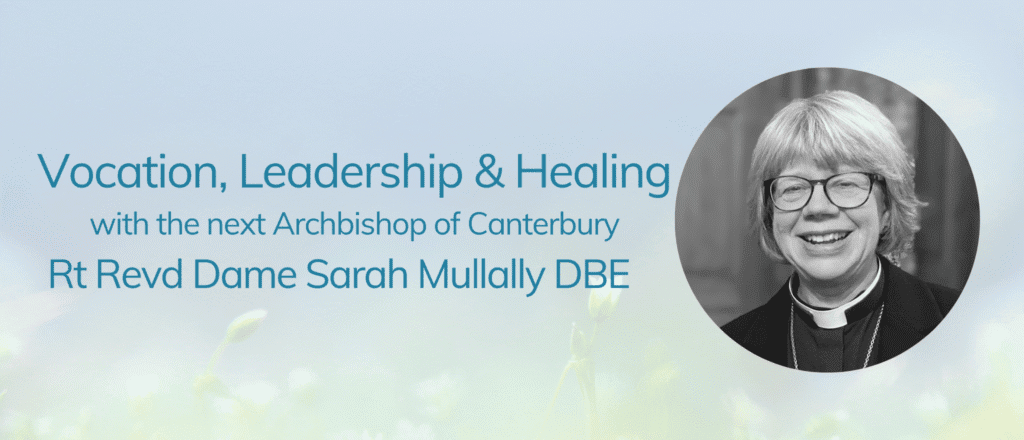
In this conversation, Rt. Revd. and Rt. Hon. Dame Sarah Mullally talks to Gillian Straine about her life, her models of leadership and the ways that holistic healing has shaped her approach to service as a nurse and a priest. It is an inspiring and hopeful encounter for anyone concerned with the future of the church, for how leadership can be both humble and powerful, and how the church can meets the needs of the world today.
“Hope isn’t about optimism — it’s about recognising what God has done, continues to do, and points to a future where the best is still to come.”
Bishop Sarah Mullally
In this episode:
+Sarah and Gillian explore:
- Bishop Sarah’s reflections on saying “yes” to the call to be Archbishop of Canterbury and discerning vocation.
- How her nursing background shapes her ministry and leadership style.
- The importance of holistic health and rhythms of wellbeing for clergy and leaders.
- Servant leadership in practice—and its challenges in a culture of power.
- Cultural change in safeguarding and creating safe spaces in the church.
- Practical ways churches can engage in social prescribing and community health.
- Bishop Sarah’s hopes for the church and the nation as she steps into her new role.
Links
Join the GoHealth Community: www.gohealth.org.uk
Look out for our upcoming reflective course based on this conversation, launching ahead of Bishop Sarah’s installation.
Biography
The Right Reverend and Right Honourable Dame Sarah Mullally DBE
Born in Woking in 1962, the Rt Revd and Rt Hon Dame Sarah Mullally DBE is one of four children, with two sisters and one brother. She attended Winston Churchill Comprehensive School and Woking Sixth Form College. She became a Christian at the age of 16.
Bishop Sarah was educated at South Bank Polytechnic and Heythrop College, University of London. Before being ordained, she worked as a nurse in the National Health Service, which she has described as “an opportunity to reflect the love of God”.
She specialised as a cancer nurse and became a ward sister at Westminster Hospital, before being made Director of Nursing at Chelsea and Westminster Hospital. In 1999, at the age of 37, she was appointed the Government’s Chief Nursing Officer for England in the Department of Health.
She was the youngest person ever to be appointed to the post. Bishop Sarah was made a Dame Commander of the British Empire in 2005 in recognition of her outstanding contribution to nursing.
While working as the Chief Nursing Officer for England, she discerned a call to ordination and entered training ministry at the South East Institute for Theological Education. She was ordained in 2001 and served her curacy in St Saviour’s Battersea Fields, initially as a self-supporting minister, before leaving her Government post in 2004, which she has described at the time as “the
biggest decision I have ever made”. In 2012 she was installed as Canon Treasurer at Salisbury Cathedral and three years later took the role as Suffragan Bishop of Crediton in the Diocese of Exeter, the fourth woman to become a Bishop in the Church of England. She was consecrated at Canterbury Cathedral, alongside the Bishop of Gloucester, Rachel Treweek. On 12 May 2018, Bishop Sarah was installed as the 133rd Bishop of London at St Paul’s Cathedral, the first woman to hold the role.
Bishop Sarah sits in the House of Lords as one of the Lords Spirituals, having been introduced on 24 May 2018. Her maiden speech paid tribute to the NHS on its 70th anniversary, telling the Lords: “I am the Bishop I am today because of that first vocation to nursing, and compassion and healing are constants at the heart of who I am.” She was sworn in as a member of the Privy Council in March 2018 and became Dean of Her Majesty’s Chapels Royal in July 2019.
As Bishop of London, Bishop Sarah has spoken regularly of of enabling “every Londoner to encounter the love of God in Christ” Bishop Sarah led the Church of England’s Living in Love and Faith process from 2020 to 2023. This included the formative stages of discernment and decision making which saw the introduction of the Prayers of Love and Faith for same-sex couples. She has served on the Church’s National Safeguarding Steering Group and is also Lead Bishop for Health and Social Care issues.
As a Lord Spiritual, she has drawn from both her pastoral experience and her background in nursing and healthcare and has played a key role in the ongoing debates on assisted dying. This year, she chaired the Triennium Funding Working Group that developed the Church of England’s three-year spending plan that led to significant investments in local churches and parish clergy.
Bishop Sarah is married to Eamonn, an Irish-born IT and Enterprise Architect who enjoys beekeeping and volunteering as a London tourist guide. The couple have two grown-up children, Liam and Grace. She has continued her interest in the health service having been a non-executive director at the Royal Marsden NHS Foundation Trust then at Salisbury NHS Foundation Hospital. She is Chair of Christian Aid. She has spoken openly about her dyslexia, describing her difficulties with writing and reading. In her spare time, she loves cooking, walking and pottery.
Transcript
Transcript
Gillian Straine: Welcome to the Go Health podcast. I’m Gillian Straine, Chief Executive of GoHealth, an organisation with a vision to enable churches and individual Christians to be a healing presence in the world. And on the GoHealth podcast we have great conversations to inspire us all to connect health and faith and make a difference in the world in the name of Jesus Christ.
And I am delighted to be sitting here in the old deanery right next to Saint Paul’s Cathedral, with the next Archbishop of Canterbury, the Right Reverend and Right Honorable Dame Sarah Mullally.
[MUSIC]
Bishop, thank you for joining us on this.
Bishop Sarah: It’s my pleasure, my pleasure.
Gillian: It’s really lovely to see you again and thank you for giving us your time, because it must be a really busy period for you right now. How are you balancing everything? In these few final weeks before you shift roles, how’s it going?
Bishop Sarah: Well, I mean, my life’s busy anyway, so, but, there are clearly some things that I’m having to do around preparations so it is a bit of a squash of my diary, which my office are managing wonderfully really.
Gillian: Yes. Yeah. Was this expected for you to get this role? When did you get the news? And, you know, how did that feel?
Bishop Sarah: I didn’t think I did expect it, for for lots, for lots of reasons really. So in fact, I’ve only really known probably about, the announcement was just over a month ago now, and I probably only knew a week before that.
Gillian: Waow, okay. And it’s like a light switch moment, you know, it’s not happened yet, but that’s a moment, isn’t that surely?
Bishop Sarah: Yes, I think I think a lot of people think it has happened. But, you know, I’m the Archbishop of Canterbury designate at the moment and as, important for me to lay down London well, you know, I’ve been here seven and half, half years. And therefore there’s something about, laying that down, well, continuing to care for and support the clergy and the parishes here and making sure that the transition works well for them.
Gillian: Because endings are so important aren’t they.
Bishop Sarah: Oh Absolutely. Yeah.
Gillian: Want to do that well…so Archbishop of Canterbury designate, some say it’s an impossible job, and there must be an enormous to do list ahead of you, how do you begin to frame this role in terms of your vocation? How did you know to say yes?
Bishop Sarah: I think for me,it wasn’t something that I comfortably set into the process. It was. I sort of resisted it for a little while, I think it’s fair to say. But there is a role description that I think will become more visible, particularly around, as you move towards the installation. And I think for me, the moment came when I looked at what they were looking for, the gifts, the experience I think you’re looking at. I thought, well, actually, you know, God has given me an experience. He’s given me gifts, that maybe for such a time as this. And for me, it’s always been a discernment, always my roles, whether in the secular, in the church, always discernment with God. And so it’s about discerning about whether, you know, what the church believed it, you know, it was looking for, what the CNC believed it was looking for at this moment and, and therefore what I offered. So I think for me, as the process went on I had integrity about who I was and what I wasn’t and therefore saying this is what I have to offer and for the CNC to discern whether think that’s what the church was looking for in me at that time.
Gillian: But I’m hearing, what you’re saying, this is almost felt like a gut reaction to it, because no one I imagined can look at that list, that to-do list, that job JD, and think, I could do that…right…there must be like, okay, what what is it I’ve got the energy to do that, or I’ve got the experience needed, or I’ve got the bandwidth to hold it. I mean, that’s…
Bishop Sarah: Yeah, I think the thing that we all learn is that, all role descriptions will have a vast amount on it. And, and I think it’s about saying, well, what is it that I’ve got to offer to it, and also how would I undertake this ministry if I were called. So for me, you know, the role of the Archbishop of Canterbury, not not to negate the responsibility, is is always a shared responsibility. And I will do this in the same way as I’ve done everything, in partnership, in collaboration with other people. It is a shared ministry. And I think for me, my experience and my background has been about building good teams of people and healthy cultures, and that’s what I bring for this moment at this time.
Gillian: And that phrase, healthy culture, I think, I think the culture that you’re stepping into or we’re surrounded by or swirled into and so it’s it feels like a living thing almost, that we have to wrestle with, doesn’t it? And, and stepping into that as well. It feels like something you need to equip yourself for.
Bishop Sarah: Yes, so I think the thing is, there’s always, you know, you always build on ministry that has gone before in whatever role you come into, so you build on what has gone before and what what I suppose I hope to do is to nurture and encourage those things that are positive and good and try with others to improve those things which are more challenging. And so to do it, one is you can’t do it alone. And actually you have to be equipped both spiritually, but also in terms of the skills that you bring with you, you know, you have to, you know, you have to do it together in a way that, makes the best use of the skills you have got, but also the skills that other people have gotten that you may not have.
Gillian: Yes. Yeah. Are you doing anything particular to equip yourself right now?
Bishop Sarah: So I suppose, an important bit is to carry on doing what I do that I think helps me, both spiritually, mentally and physically. So, you know, I continue to make sure that my prayer life is good, that I got a rhythm and a pattern. And to begin to think about, how will how will that adapt into a new role? I still jog very badly every morning, you know.
Gillian: Do you? That’s brilliant.
Bishop Sarah: Yeah. Very badly. And I still, you know, and I, and I ride a bike a lot. So it’s about saying, how do I, how am I going to do those things, what will they look like in the future? And, and clearly with any run into any role, you know what you know, what you don’t know is what you don’t know. So there’s something about equipping me, getting a better understanding of, I suppose, what the role involves, but also the people that are involved in that and beginning to think about what will it look like after next year?
Gillian: I love as former chief nurse, you started that with talking about your health, your holistic health, right. So I want to go a bit deeper into that word vocation that you’ve, that you’ve used. And of course, I’ve just mentioned you were the government’s chief nursing officer. Now, you’re, you’re living a vocation as a priest in both worlds, a vocation, maybe to senior leadership. How do you understand vocation in your choice of what you do in the world?
Bishop Sarah: Yes, so for me, vocation is to, I suppose…I have a calling to follow Jesus Christ. The vocation is working out how that, how does that work out in the world, so what is God calling me to do with my gifts and my skills? So for me, I’ve, I suppose I would feel that I’ve had one vocation, which is to follow Jesus and use the gifts I’ve got. That has enabled me to be a nurse and a priest. And therefore working that out in, in terms of what that looks like, so certainly when I was a nurse that for me was a vocation. It was around that sense of Christ’s healing hands in the world. And whilst people may not recognise Christ in that, it was for me, a Christian calling to be a nurse. And for me as well, there is a continuation through into being a priest and a bishop and a, you know, I’m the bishop and the priest I am today because of being a nurse. You know, I can’t change that. I am who I am because of that experience.
Gillian: Yes. Yeah. It sounds, there’s a thread around healing. Do you recognise that, that thread of healing, is that..?
Bishop Sarah: Yes. I think the thread, I mean, whether it’s healing or whether it’s around wholeness, I would now describe as Shalom, that much broader sense, but even when I started training as a nurse, I was very fortunate. The, the training program I did was one, a holistic one. It looked at wholeness. So it wasn’t just, it wasn’t based on a medical model. It was based on a model that looked at the social, emotional, physical, mental, you know, the whole, the whole branch of it. So, and therefore, I think right from the beginning I had a model of healing that was much broader than that physical sense.
And, you know, being a nurse, we used to push against the medical profession because we would say that they had a medical model and actually we had a much broader model as nurses. So so for me, that has always been there. And certainly in my day, we used to do a full spiritual assessment along with the nutritional assessment. So so it was a quite a holistic model. I think for me now looking back on it, I think, nurses love to fix things. And even with that holistic model, I think I probably wanted to fix things. And I more as a priest, I think I’ve understood that, one is actually I can’t fix things in the same way as I did as a nurse anyway, but actually to sit in those places where people aren’t cured, but they may be whole. And I think I’ve had a much better understanding of that. And I recognise that actually fixing things may not be what you called to do in some moments.
Gillian: So I’m not am, I have no medical background, but I’ve been in hospital a lot and had lots of experience of nurses. And for me, the good nurses are the ones that have presence or they let a bit of their presence connect with your presence. And that’s, that’s a gift and some don’t have it. And for me, the priesthood also is about presence. So I wonder if that’s another thread?
Bishop Sarah: It is of course, the, the sense of presence was something that Dame Cicely Saunders spoke a lot about. And being present is you’re with somebody in the moment. You’re not thinking about what’s happened or what you’re going to do. So how you are present with somebody. And so she, she wrote quite a lot about that. And, and for me, that is, you know, I recognise that that’s both true for the nurse and for the priest. And so how you present with somebody in, in the nursing situation, but also as a priest, how you present and how you with somebody and and I think the challenges to that people operating that presence are probably not dissimilar in both areas. I mean, the NHS is is overworked, nurses have less time to spend, I think, with people these days. So therefore how you build that relationship is much harder. And I also worry, you know, sometimes we put the pressure we put on priests as well means that that, you know, do do they really feel the, the opportunity and the time just to be present with somebody? And of course, we know that the best priests are those that are able to do that.
Gillian: And it matters to their vocation and their humanity doesn’t it, you know, the levels of burnout within the medical care profession, because there’s so much pressure. You’ve got three seconds for the patient, then you’ve got to move on. And it’s really debilitating for the healers who want,they don’t want to be doctors like that or nurses like that. And the same with priests.
Bishop Sarah: You know, I think, well, I think it’s always hard, isn’t it? You know, people often ask me, do I miss nursing? And because there’s such commonality, in a way I don’t, but what I do miss is changing a tracheostomy tube, the tube that you use for breathing, that just sits, you know, it’s just down in your trachea. And so you do have to regularly change the tube and you need to care for the patient. You need…the person needs to trust you. You need to spend time with them to be able to do it. And actually there’s a degree of technical ability as well. And when you’ve done it, it all looks nice and clean and tidy and and the patients relaxed and they’ll have it done again. And so you can immediately see the product of what you’ve done. I think the challenge for parts of nursing, but also as a priest is how do you measure your product if you’ve sat with somebody and just listened, you can’t measure that. So, so there is something about how do you, we as a, as you know, people who are providing oversight and care, ensure that we can let clergy know we trust them, we trust them to, in what they’re doing with their time and that they will make the right decision to spend the right time in the right places.
Gillian: Yeah, yeah, I I’d love to talk a bit more about leadership. Do you have a particular model for your leadership? And will it change as you go into the See of Canterbury?
Bishop Sarah: So for me, fundamentally, whether as a nurse or as a priest or a bishop, my model has been based on that sense of servant leadership. And so, interestingly enough, when I was in, a director of nursing and doing some, one of the sort of leadership programmes you do, I was most struck by, a piece of work that came out to the States, I think it’s Peter Greenleaf, and it was around servant leadership. And although it was for secular organisations, it came out of the model of Christ being the servant, the servant leader. So for me, fundamentally, that’s that has always been my model. So therefore washing feet, whether in nursing or, as a bishop, is for me a very powerful symbol and that sense of which, living in the service of others. That’s how I see myself. And I was interested recently that, Selena Stone in her recent book, I think was the heavy, called The Heavy Yoke. And she talks about the risk of using that as a, you know, you can use it as a sort of force model. So you have this model of leadership, servant leadership, but it can be more coercive. And I, it was interesting to read it because I’ve always, that’s my model. And I suppose there is that bit about recognising if you’re somebody powerful, having a forced humility with it, then you have to guard against it. But my model has always been about living in the service of others. So therefore I only lead because I’m living in the service of others. And therefore what does that look like? And I also think the model of the chief pastor is important. So whether it’s been, you know, the Department of Health or now as a bishop, I’ve always tried to live in the service of others, care for them, enable them to be the best they can be, and to lead in that way, that has always been my model.
Gillian: And I guess one of the, the hazards for senior leadership, and maybe it’s countered by the servant leadership model, is the attractiveness of power and authority as well. I think I was reading something on what traumatised institutions do. It wasn’t about the church, it was about other, what many traumatised institutions out there. And when an institution is traumatised, so the senior leaders will tend to persecute the further down leaders and abuse of power. Not on purpose, not you know, wake up in the morning and think I’m going to abuse my power and feel more important, but it’s almost subconscious because there’s fear around. So in what ways does a servant leadership model, that is exemplified here in London, help to counter some of this stuff?
Bishop Sarah: So I think the first thing is, I often see myself as I’m just Sarah, but I do, you know, I am Sarah the Bishop. I sometimes sit in a purple shirt. So I have become very aware that if I phone somebody up or I invite them to have a conversation, because I’m being pastoral they won’t…their first thing is, why is the bishop doing this? So I think I’ve learned that inherent in your role, you have power and you have to work out how do you make sure that you, enable people to feel comfortable with you.
And so they trust that it’s not about you checking up. It’s actually you just generally care. So. So I’m very, you know, I am in a sense, I’m very conscious of that. But I also feel slightly, you know, fortunate that I have been in positions where it has at times…you know, I was the youngest government’s chief nursing officer. I was not expected to get that post. And immediately with that, there was some criticism of that. You know, I’m the first woman Bishop of London. They didn’t expect a woman to get that post. So I have been in positions where often I, you know, I felt, that, you know, people, people haven’t just accepted me as the Bishop of London because there’s other baggage that goes with being a woman, for example.
So, so therefore I’ve, I’ve always slightly felt that it’s much easier for me not to become too full of power, because actually, often I feel that I don’t have it because of sometimes what people say about you as a woman, you know? But I do believe you have to guard against the fact that even in that office, you have power, that other people recognise you.
Gillian: And, you know what, Bishop Sarah, I like I don’t want to ask this question, but I want to, I’m going to ask a question about being a woman leader.
Bishop Sarah: Yeah, yeah…
Gillian: The first here, the first there and the first somewhere else on that coming up as well. How does that change things for you, having to redefine the role maybe in some ways?
Bishop Sarah: So interestingly enough, it’s the only way I can do it. That’s who I am. So, and so I’m aware of that, but I’m also aware of, the nature of being the first. And so Adrian Newman, who preached at my consecration as a bishop and bishop Rachel’s was consecrated at the same time, talked about the subversive nature of women in the Bible, and, but also the social nature of them. And he encouraged Rachel and I to be subversive and to socialise. Now, I don’t necessarily see myself as subversive, I’m pretty ordinary, really. But I do know, being the first Bishop of London, I just have to turn up at the beginning and I was subversive by my presence, because they had not had a woman before. But, but what I do is I do what I do in the way I’ve always done it. So I do it with the integrity of who I am and the way, therefore I have always led, I will continue to lead. And the model I have of being a bishop and an overseer is the one that I will always do. And so I wouldn’t do the same as other women, but I won’t do the same as men. And so I think I have partly because my background in health service, which of course had more male leaders than female leaders, I learned that I had to do what I do with integrity. I didn’t have to behave like other people, and I think I would that that for me was it was important. But I do know purely by turning up…
Gillian: Yep.
Bishop Sarah: …in places where you’re the first as a woman, it brings with it, you know, you are automatically subversive.
Gillian: Yeah. And what I found really moving, has been the way you’ve led with vulnerability. I remember the speech you made at Synod, and I was moved to tears listening because you showed your vulnerability and your heart, which, showed the way you’re leading, and that shifted things. But on the counter to that, you’re facing appalling abuse. I don’t know if that’s the word you use for it, but discrimination, misogyny, nasty stuff. How do you protect yourself?
Bishop Sarah: Well, I think the first thing to recognise is that a lot of people are very supportive. So there are lots of people. But but I also feel that I, so something about, how do you have integrity as a leader, you do have to say when you’ve done things wrong, you do have to own up to them and put them right. So I have learned as well, you, you know, there is that and it’s not a forced vulnerability. But you do have to say to people, actually, I’m not going to get everything right. I haven’t, I’m not going to. But I will be clear when I haven’t got things right and I will be, you know, try and put them right. And, and in terms of showing the vulnerability when things are difficult, I think I’ve become much more honest about when things are difficult. It is not something that I’m necessarily proud of. I show too much emotion sometimes because I… there’s a bit about you feel you, you know, you have to present to a good face that’s in control. But sometimes, it does catch you. And I think, you know, somebody says the language of tears is important because it says something that’s been inside and and therefore you express something and you have to listen to what it, what it’s saying. You know, sometimes you are you accumulate baggage and sometimes it’s just sometimes that point where you think actually, you know, it’s difficult. And I think it’s also difficult in that, you know, I think there were a whole group of people who were very, who were also very touched at the same time, but there was also somebody who thought I was being coercive, you know, by doing it. So you, you have to live with the two, you know, you have to recognise there’s, a different narrative. But I think there is something that all of us as leaders, whether women or men, is that we, I don’t like saying that we have to be resilient because I’m not sure that necessary is the right language, but we do have to look after ourselves, and that is about making sure that, you know, whatever it is that does our spiritual and mental health, physical health, we have to do those things. And therefore, I think that we have to take seriously not just spiritual directors and work coaches, but actually clinical supervision, pastoral supervision. And if we need it, counselling, because you have to work out how…In a sense, what I try to do is find a rhythm to my life. The stuff that gives me energy, along with the stuff that sometimes takes it away from me. And I think that’s important for all of us in ministry.
Gillian: It is. And modelling it, the more senior person modelling good stuff, really helps those on the ground, because so many clergy are struggling right now with their health, with their mental health, and struggling not just because they don’t know how to look after themselves. Their wellbeing issues are rooted in their struggles with the institution and the church that they’re working in. What might you say to those folk?
Bishop Sarah: I think we have seen an increasing responsibility. We may not have gone far enough, but I think we, we have and and you can see that in, in terms of the discussions, for example, around, the, the, the funding of the Church of England this year with the training and funding working group taking seriously, you know, funding of the pensions and of stipends and also support for those in training. So in, in some way beginning to say we, you know, we listen to what people were saying and we’ve begun to try and respond to that. And I think also, in the Diocese of London, we have begun to say, you know, we do take your wellbeing seriously. How do we begin to structurally support you? So, for example, you know, access to counselling, access to reflective practice groups, but also saying, you know, in our processes. So whether it’s, our process around clergy disciplinary measure or safeguarding that we’re putting people in place who can provide good pastoral care for people who are caught up in those processes. So we have to do something about, not just modelling it and encouraging people to take time off. But how do we put some structural things in place that begin to say, actually, we are trying to, you know, we’re trying to get some of those points in place to help you in, in, in that way and very little things like not sending out information on Friday or, you know, information in Holy Week or…
Gillian: Yeah, and that’s cultural change, isn’t it.
Bishop Sarah: It is.
Gillian: And and getting that to shift as well. And in turn, another question about healing, there’s a lot about healing because it’s GoHealth. The church so often is accused of wounding others. What’s your approach to safeguarding and how can we move forward with that, again, the cultural change that we need right now, it’s so often in the media, it’s an ongoing issue that we’re all dealing with. How do we move forward around safeguarding and healing?
Bishop Sarah: Well, I think the first thing to say that for me safeguarding is at the heart, in a sense it’s at the heart of the gospel, really. You know, God has always been my fortress, my tower, my strength. And therefore, as a church, we should be that place of safety as well. Everybody’s made in the image of God. And therefore it is our responsibility to make sure that we, we create environments in which individuals feel safe. And I think that there is no doubt that the church has caused harm to people in the past. And we have to recognise that. But also part of recognising and apologising is doing something about it. And I think we have seen a huge improvement in safeguarding, you know, over the years, it has changed. And I and I think the two, you know, a couple of things for me that have changed. One is the cultural. So you know, people take safeguarding seriously. I met recently with some parish safeguarding officers who take what they do absolutely seriously. And, and therefore that cultural shift has really happened. Also, I think we’ve seen better resourcing. And so for example, you know, even in the Diocese of London, in the seven and a half years I’ve been here, the resourcing for safeguarding has incredibly increased. And that’s not just financially, in numbers of people, but the skills of those people. And actually, we’re beginning to take seriously, involving the voice of survivors in what we’re doing. It doesn’t mean to say we’re there, at all, because that is, you know, it’s our responsibility every day, to, to make sure that the environment is safer. But I do think we have made, significant strides, to do that.
Gillian: And thank you. And as a priest, I’ve seen safeguarding training and, the culture shift enormously. But I’ve also seen the public feeling or sense of the church is still in the media an awful lot. The abuse in the church, it’s what…it’s part of the culture now, how do we begin to heal and raise up public ideas that it’s a, it’s as safe as it is?
Bishop Sarah: The first thing, often often it relates to the way in which you relate to the church. So, so going back to the parish safeguarding offices, actually, that is part of it. So people come to church, they experience it as being a safe place. They see, you know, on the wall, you know, we’re taking, you know, safeguarding seriously because the parish safeguarding office is there. So there’s, there’s that first immediate thing because of course the public are made up of individuals. So that’s the first thing that’s really important for us to to demonstrate that. I think also, INEQE have been undertaking audits now throughout diocese. I think we’re pretty at that up to 19.
Gillian: And INEQE is?
Bishop Sarah: INEQE is… it’s an independent body that is auditing safeguarding in diocese in the Church of England. And they will publish their independent report. So we’ve now got information for people to go to and begin to see what an independent body is saying about our safeguarding policies and procedures. And I think that is something that we ought to begin to, refer back to and to show people, that, what we’re doing in that way. So I think that is the that is the other bit of saying, look, actually, this is what an independent body is saying about us. And then, I think we do have to continue to be honest and show with integrity when things do rise and to, to, to be undefended about how, how they have been dealt with. And, and I think it is true that all of us, whoever we are have to be open to having a light shone on what we’re doing and to be undefended in that way.
Gillian: Yeah, I enjoyed your article in the Church Times on the NHS, and your highlighting of the role that faith based organisations of all sorts can take part in our health service, or in addressing health inequalities in our communities. What can you say to people, to church leaders on the ground to, encourage them, to connect their ministry, with not necessarily the NHS, but with the health and healing that’s possible through partnership.
Bishop Sarah: Yes. So my my sort of encounter with churches is that there are a whole range of churches and individuals who, who have this much broader model of health, which is both spiritual, physical, and mental wellbeing. And churches that see the opportunity to try and engage in it on a, on a much broader sense to know that actually within their churches, they may be doing things that they could offer, which doesn’t require a huge amount of effort, really. And, and, and that surrounds, social prescribing. So, so there is now the ability for GP’s to be able to prescribe activities, social activities that contribute to the wellbeing of individuals and, and one of the great shifts that we’ve seen is an understanding within the medical profession and broader health that actually, you know, loneliness, isolation from people, a lack of meaning are things that, negatively contribute to health. So if you can prescribe something that whether it’s sport or a club or a coffee morning, actually you help somebody, you will improve somebody’s health. And so churches, we are places of connectivity. We are places who who offer a welcome. You know, there are people now, running knitting groups and coffee mornings and, you know, games evenings and those things could all be prescribed and therefore that the, the you know, if there’s a church that thinks, actually, I might like to get involved in that, the easiest way to do it is to phone up your local GP and say, who is your social prescriber? Or who do I talk about social prescribing? And there are people locally based that you could then say to them, look, these are things we offer that actually you might be interested in prescribing. And it is, it is just the ability to connect up the things that we’re already doing that you may just find that people would want to come along and do, do and contribute to their wellbeing in a in a creative way.
Gillian: And church is expert in that. Mum and tots, cup of tea. We’re really good at that.
Bishop Sarah: We’re really good at.
Gillian: And we can measure, we can measure something actually, the health benefits. But what would you say to church leaders? Because sometimes what I come across, Bishop Sarah, if people saying, well, that’s not the church needs to be about bums on seats and telling them about Jesus and growing it, because when they get it, they get it – the health mission, it’s how do we help those who aren’t able quite to make that connection, that that’s ministry.
Bishop Sarah: Yeah. Well, I well, I mean, well, it is, – I mean, we’re called, aren’t we, to preach the gospel in both word and deed, and sometimes the deed bit is, is, is offering that that that undefended welcome to people. And and so for me I find it difficult to separate the two and therefore, and this is, this is a way of doing something for churches that, that doesn’t necessarily mean they have to do much more than they’re already doing. And and you talk about the wellbeing of clergy, you know, this isn’t about putting on something new. It’s about using what you’re already doing. That’s the, that’s the great thing about social prescribing is that, you know, if you’re already running, running a Thursday morning coffee morning, it’s about opening it up to a few more people. So the resources you need aren’t, aren’t, you know, it’s not about huge step changes. And I think that’s the that is the opportunity to say this is about building on what you’re already doing and actually it’s great because you may find there are new people that come in and and some of the experience is, although you don’t do it in a way for people to come through to church, actually the experiences that, that that often what happens and and, you know, I was at a food bank recently and users of the food bank had then moved into being supporters of the food bank, had moved in to being part of a new church.
Gillian: Yes. Wonderful. Yeah. I don’t know if you heard the Sunday show on BBC radio four this week. There was a chap on called Jack Guinness who apparently you met soon after he was born, and you took him a baby blanket. Do you remember that blanket?
Bishop Sarah: Oh I do, yeah.
Gillian: 1982. Do you?
Bishop Sarah: So, so I it was, I was a student nurse, and and so therefore, in one of the summer holidays, when Jack was due, I looked after his brother and sister for, you know, I went to help look after them while Jack was being born, and it was, and so, so I went with, his brother and sister to buy this baby blanket. I can even remember what it looks like…
Gillian: What did it look like?
Bishop Sarah: Well, it was it was a blue knit. It it was a blue square knitted one and blue and white in it. And what I amaze at, is that that he remembers it.
Gillian: He does remember. And he sent you a message to say, thank you for the blanket and to say his family are all behind you now, which is sweet. And he’s very excited about the future, with you as Archbishop, do you have a message for him, perhaps?
Bishop Sarah: Oh, I think, I think I hope that he that he never underestimates the impact that he had as a child on me and also his, his sister and his brother. Yeah.
Gillian: Oh, that’s lovely. Finally talking about hope, this is from my final question. What’s your hope for the church and the nation? It’s a big question, for the coming years, as you take up, the role as Archbishop of Canterbury.
Bishop Sarah: Well, I know we talk a lot about hope. And, of course, we have to remember that hope isn’t about optimism. It’s about, you know, our hope is about what God did in the past through Jesus Christ, continues to do today and points to a future, you know, that is, you know, that says the best is still to come. So that’s where our hope is. You know, what I would want to see is that hope nurtured in individuals and in churches so that they continue to grow in confidence about who they are called to be as individuals and as churches, and to find that confidence in Christ.
Gillian: Bishop Sarah, Archbishop to be, thank you so much for your time. Please be assured of my prayers…
Bishop Sarah: Thank you.
Gillian: Personally. And GoHealth prayers, as you say goodbye to London, where I know you’ve done so much healing work and have been a great example to so many of us. We’ll be praying for you as you take up this new role. Thank you for saying yes to the call. Not yes to the podcast. Yes, to the call. We’re behind you, and I, And you know what? I’m really pleased to you.
Bishop Sarah: Thank you.Well, thank you very much for all you do as well.
Gillian: Thank you. We will be producing, I don’t know if you know about this, we’re going to produce a little, online reflective course, based on what you’ve said today. We’ll be releasing it a few weeks before your installment, your installation.
And, if you’ve been interested in this podcast, do come back and check out the reflective course where you can dive deeper into the conversation, reflect on your own response to what Bishop Sarah has said, particularly around hope, and join us in praying for her with new prayers. So here at the GoHealth podcast, the conversation doesn’t stop, we continue it in the GoHealth Community, which is our space to gather and to seek inspiration for how to flourish in health and healing. As a member, you’ll receive weekly email inspiration, access to all our courses, and the chance to connect with others who share this vision of health and faith working hand-in-hand, you can find out more and join us at GoHealth.org.uk
A huge thank you to Rosie Dawson for producing the podcast, to Joe Lee? for his work on the sound, to Wendy Lloyd for all her work on the podcast and in the GoHealth Community. So until next time, thank you for listening. Thanks once again to Bishop Sarah and may you know God’s healing presence in your life and in the world.
Bishop Sarah: Thank you.
Gillian: Thanks. Thanks so much.
Dive deeper with GoHealth

Are you a leader?
GoHealth, we support leaders to flourish personally and in their teams. Through theologically grounded and scientifically informed training, coaching, and reflective practice—online and in person—we help leaders nurture wellbeing, build healthy cultures, and lead with clarity and purpose. Our approach is trauma-aware, values-driven, and designed for those shaping organisations that make a meaningful, positive impact in the world.

Join the mailing list
It’s the best way to hear about all of our upcoming courses, events and news.

Explore our online courses
There are lots to choose from! Perhaps you are interested in mental health, healthy working, or being trauma informed.