


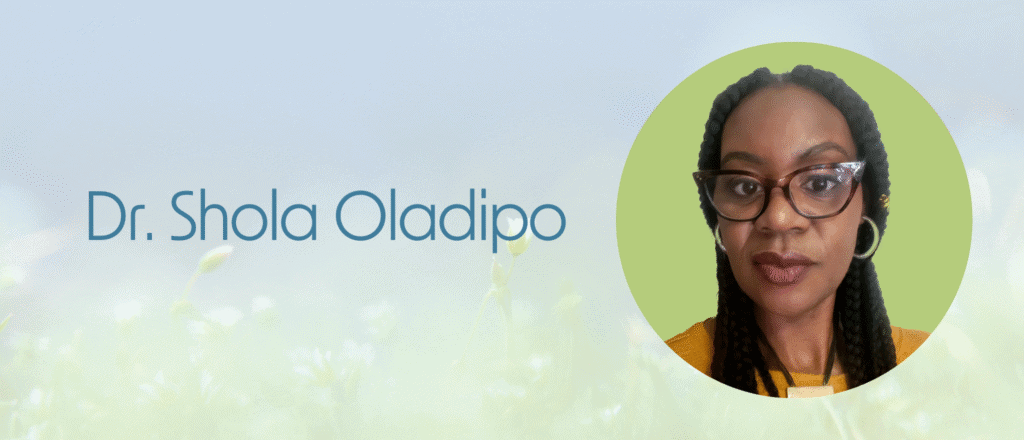
In this episode of the GoHealth Podcast, CEO Gillian Straine sits down with Dr. Shola Oladipo, a registered dietitian with nearly 30 years of experience, researcher, pastor, and CEO of Food for Purpose. Shola’s pioneering work sits at the intersection of faith, food, and health — equipping Black Majority Churches and wider communities to embrace culturally relevant approaches to health and healing.
All the stuff you do for your spirit and your soul is great. But the container — your body — if the container is broken, you can achieve nothing. We need to help people direct their gaze to the container, to give them space, and help the container hold the precious contents of the spirit and the soul.
Dr shola oladipo
In this episode:
Shola and Gillian explore:
- Shola’s story of food, family, and faith growing up in the Pentecostal church.
- The Rest–Digest–Reset project and how it is reshaping health through community co-design.
- The unique health challenges facing Black, African, and Caribbean communities — and what mainstream health systems often overlook.
- Why “cultural relevance” matters so much in healthcare.
- The deeper barriers to health, from chronic stress and hypertension to the “weathering effect.”
- How church leaders can be powerful agents of change — while also needing care themselves.
- The theology that helps us connect faith with health, and how slowing down to “find the pace of God’s love” can itself be an act of healing.

Here are Gillian and Shola Oladipo at a recent conference. Shola is a registered Dietitian with almost 30 years’ experience, bringing together nutrition, faith, health, and culture. A doctoral researcher exploring how faith shapes health behaviours in Black African–Caribbean church communities, she is also a speaker, writer, and media presenter.
As founder of Food for Purpose (FFP CIC) and a pastoral leader in a Pentecostal church, Shola offers a holistic, faith-informed approach to wellbeing that is transforming health outcomes in diverse communities.
Links to find out more
Join the GoHealth Community: www.gohealth.org.uk
Find out more about Shola’s work: Food for Purpose
Biography
Shola Oladipo is a registered Dietitian with almost 30 years of professional experience, blending expertise in nutrition with a passion for the intersections of faith, health, and culture. A member of the British Dietetic Association (BDA), she has worked extensively across the NHS and the nutrition industry, championing healthier lives within diverse communities.
Shola is also a doctoral researcher, exploring how faith influences health behaviours in Black African–Caribbean church communities. Alongside her research, she serves as a conference speaker, writer, visiting lecturer, and media presenter, bringing insight and practical strategies to audiences in the UK and beyond.
In her pastoral leadership role within a Pentecostal church, Shola connects her professional expertise with spiritual care, offering a holistic perspective on wellbeing. She has featured on Premier Christian Radio, BEN TV, ROK TV, Revelation TV, and Vox Africa.
She is the founder of Food for Purpose (FFP CIC), a community interest company dedicated to transforming health outcomes through culturally relevant, faith-informed approaches.
🔗 Explore more: Food for Purpose Linktree
Transcript
Gillian Straine: Welcome to the Go Health podcast. I’m Gillian Straine, Chief Executive of Go Health, an organisation with a vision to enable churches and individual Christians to be a healing presence in the world. And on the Go Health podcast we have great conversations to inspire us all to connect health and faith and make a difference. And today we’re doing just that.
We’re doing what we love most, bringing you rich, grounded conversations where science and deep Christian wisdom meet. And we’ve got a fantastic guest, Dr Shola Oladipo, who’s a registered dietitian with nearly three decades of experience. Shola is the Chief Exec of Food For Purpose, a non-profit dedicated to improving health in black, African, Caribbean and global majority communities. Shola is the creator of the award winning Healthy Church Initiative, and her PhD research explores how black majority church leaders can influence health behaviours and address inequality.
So Shola is working at that vital intersection between faith, food and health, partnering with churches, the NHS and local councils to bridge gaps and bring health and healing where it’s most needed.
Shola, it’s a joy to be chatting with you today. How are you?
Dr Shola Oladipo: I’m really well, thank you so much for having me, Gillian.
Gillian: Well, I’m so excited. And you know what we’re talking about food. And I was looking back over our podcasts over the last few years and our website, we’ve not talked about food on our podcast yet, which is like. Which is a bit mad, isn’t it, because it’s so fundamental to everything. So for you, food, what’s your earliest memories of food and faith and community?
Shola: When I think about it, my earliest memories of food are actually a blend of my British Nigerian culture, so my parents came to the UK in the late 50s and early 60s, and they were that cohort that came into to study. So my father was a civil servant. He was doing a Masters here, and my mum came in to study as a nurse.
So, by virtue of that, my older brother and myself were actually, lived with a nanny, a British, British nanny. We had a few nannies, but we had two in particular. One lived in Hastings and one in Southend. So in terms of food, I remember as a child our sort of early Nigerian food, you know, pounded yam, jollof rice.
But then when we lived with nanny, I remember like toad in the hole, steamed puddings, bubble and squeak. Something that not many people now called braun, which is an interesting, mix of, I think it’s certainly offal and it’s eaten…
Gillian: Really.
Shola: it’s not very nice…Blood sausage. Good old fish and chips, I mean, real fish and chips, right? So my memories of food, interestingly, are, that’s really strong British diet. And then mixed with my, you know, cultural, African foods which have really shaped my rhythm in terms of eating. So, you know, I pride myself on, you know, being a British Nigerian and knowing all the traditional foods and loving them and having a love of Caribbean cuisine. But also, do you know what, Gillian, when the chips are down and it’s freezing outside, I’m that girl that wants, you know, spotted dick, custard, you know, a good crumble…
Gillian: Yeah, a good crumble. I think we might leave braun at the door, though, that sounds pretty gross. I think that might be not on the Go Health recipe.
Shola: It was a bit disgusting but Nanny, Nanny said it would be good for us. So we just so we just ate it.
Gillian: Probably, right? A bit like black pudding we had in Scotland?
Shola: Yes, I think so.
Gillian: So a real mix. And tell me about food and culture within the Pentecostal church. Is that a big thing?
Shola: Yeah, it really, really is. It’s funny when I think about the black majority Pentecostal church, I speak about the, sort of West Africans. So Nigerian, Ghanian, Cameroonian, Sierra Leonean church and the Caribbean church, of the 30 islands. And I think in our culture, our faith is so important, but so is food. And a lot of the time, services are appended with some kind of food.
And let’s just say a cup of tea and biscuits doesn’t always cut it. So there tends to be a little bit more going on. Now when I think about some of the after church kind of snacks. It tends to be like, you know, pastry, maybe a little meat pie and some tea or coffee or some juices.
Right, to, you know, cooked food. Jollof rice is quite a popular member of many of our congregations, Jollof rice.
Food is a big thing. It’s you know, birthdays, burials, weddings in most of our black majority churches. Most of the churches have some kind of hospitality team or catering team, which, you know, it shows us that food is, is really part of yeah, what we do.
Gillian: And it’s what I remember when I worked in a church in North London, we had, money to do inter intercultural kind of activities for women. And you know what? We cooked, we had the British, our British group. I remember leading on broccoli and stilton soup. Then we joined with a Caribbean Caribbean group and we had the Arab group, but it was all around food and we just taught each other our recipes and then hung out. And that was the whole purpose. And it really did change something in the culture. So food’s got that thing that can draw us together as well as establish our cultural identity as well. And you’re starting up a new project, ‘Rest, Digest and Reset’. Can you tell us a bit about where that came from and what’s its vision.
Shola: As a dietician or researcher and, you know, church leader I observe this, hyper activity in, in particularly amongst black majority church leaders. It’s that rush to get things done. It’s that, layering. So a lot of our church leaders are bi-vocational. You know, they are the church pastor, but they also have another job. And a lot of this, communities, particularly our leaders, have that responsibility to send remittance back home to families. So there’s a huge sort of financial responsibility and a lot of leaders, they’re trying to get a lot of things done and that that sort of hurry, that hyper-ness, leads to, to stress and, and stress manifests, in several ways, amongst which are, you know illnesses which we know black majority, or black communities have a propensity towards avoidable chronic illness. So, you know, obesity, hypertension, type two diabetes. But this lifestyle that I’ve observed compounds it. And a lot of the time leaders are not resting as much as they should. Therefore they’re not digesting that food, you know, in the literal scientific sense, but also in the sense that, you know, I am a body that needs nutrients, rather than just eating to go, there’s that, there’s that challenge of, you know, to be able to do more for the Lord and that, you know, that kind of the black majority churches sees a lot of things through a very spiritual lens, including health. So sometimes forgetting about the vehicle, which is our bodies, to actually rest and sort of digest and have that reset. And, you know, in a, in a conversation with yourself, I think you were actually instrumental in helping us to get to where we are in terms of that Rest Digest, Reset and bringing I think the whole vision is that there’s no shame in in, in rest.
Gillian: Yeah. So let’s so I really want to get on to the church leader stuff and some of the particular health challenges. And let’s talk also about that story about how we got to this project. But first, what is Rest Digest Reset actually? You know, what is it going to look like on the ground?
Shola: Great question, it’s still in the early days, but am…I’m a strong believer, you know, when we’re developing these interventions that involve people, that people should be involved. So let me just say what I think it is until we have the sort of true co-design piece in place. I envision a 21 day, a 14 day programme that leaders can sign up to, which is embedded in the Word because the black majority church is, you know, like it has to be Bible based, so embedded in the word, but actually invites people to do things that are, will help them to rest.
So, to get them thinking about journaling, to get them thinking about what they’re eating and actually focus on micronutrients. I think in the past, a lot of, church based interventions have been focused on macronutrients which have been don’t eat too much carbs, don’t. It’s been don’t, you know, don’t eat too much fat, don’t eat. And it says a lot of don’t. But actually with this micronutrient approach, it’s do. And kind of aligning those, micronutrients which tend to come from food, which have come from the ground, which are quite, bring this kind of wholeness and richness to particularly to, black African, black Caribbean cultures and thinking about the roles of those God given, substances to help with rest. So, you know, magnesium and sleep, antioxidants and reducing inflammation and giving leaders a simple task that they should think about doing. Really simple. But it’s not, you know, you must go for a walk. It’s, you know, have a walk and look at the sky for ten minutes. You know, breath in deeply and think about… And it’s really trying to regulate and reduce the hurry and to invite people, to woo people into that space of rest and to kind of bring them to a place where there’s no shame in it.
Gillian: Yeah.
Shola: There’s no shame in slowing down and resting. So that programme, will…they’ll, they’ll receive some kind of devotional piece each day. They’ll be invited to journal, we’ll take some measurements at the beginning in terms of how they feel, sleep quality, food frequency. And then at the end of the programme, we’ll do the same in between. Hopefully people will be blessed and will be, you know, rested, by the end of it.
And we’ll have some outcomes which hopefully point to some kind of a programme that can be rolled out to yeah, to, to God’s people.
Gillian: I love that phrase, you’re going to woo them because so often wellbeing stuff is list of things you should do and you must do. And the thing is we we all, we all really know what we should be doing. Don’t we, Shola? We know we’re supposed to get more sleep, we know we’re supposed to get more rest. We know we’re supposed to eat well, but we don’t. So it’s not like it’s a head problem, is it? It’s not like a knowledge problem. It’s a putting it into action or a habit, problem. But particularly for leaders, isn’t it?
And I love your approach. I remember when we chatted about this, when we met together in Durham, the other week, you shared with me that African proverb, ‘if you want to go quickly, go alone. If you want to go further, go together’. So this is, tell me more about your co-development, your approach to the project, and why you’ve chosen that way to do it.
Shola: Yeah. Thank you, Gillian. I think as a health care professional and as a researcher, there’s that desire to see results, you know. I just want you to do it. And, you know, I used the word intervention, it’s still a bit scientific, isn’t it? How about just you know, activity and, you know, those kind of words just remind me of, I’m always looking for the end result. We’re always looking for the end result. And therefore, as a researcher or, you know, author of this programme, it can be Shola’s way of, you know, giving this to you to do. And I just want results for actually if we bring people in. So it has the what we call the FUBU principle – For Us, By Us, they’re involved in it and building it. We’re going together, it’s about that true co-design. I know as a health care professional that we use this word co-design and co-production, you know, very flippantly. You know, we we have an idea already. And then we tell what we ask people what they think. But I think going together for me means there may be several iterations of this. I want to to be open to partnership. I want us to go together for sustainability, for longevity. I think if, particularly the black community, I think it’s a community who feels done too, when it comes to health. And I want to introduce something different where, leaders feel that we’re doing this together. They’re not being done to. I’m not just, it’s not just an inner, you know, people…sort-of call research is ‘a hit and run’. It’s not a hit and run. You know, I hit you, I’ve run with the results. Extract and extraction. It’s actually a process. We can go slowly and we can go together and we can build. And it will look like you, It will sound like you when you see it, you see yourself and therefore it hopefully will be more meaningful and more sustainable.
Gillian: And it sounds more spacious. I mean, you got to be high, high risk tolerance, I guess, as a professional, because you just don’t know what’s going to happen as well. And you’ve got that spaciousness for God in this.
Shola: I love that word Gillian. I do, you know, I love some of the language that you use. I love that, spaciousness, I love that. Yeah, yeah, yeah. And we don’t, you know, and I think, you know, I’m using a hand demonstrations so podcast listeners won’t see it. But we, I feel like, when I think of my community, I think of, hyper.
You know, when I think of hypertension, it’s about a narrowing of space, you know, and trying to operate in this very small space and to operate really quick, quickly and then, you know, like, you know being in a sausage machine – squeezed. And I think that there is something about that space and I think, you know, with, with our church leaders, I think sometimes there’s an assumption that, you know, they’re very sort of, you know, wise and spiritual and know it all and therefore, you know, but I realized that when it comes to their own health, a lot of us as leaders don’t know as much as we think we know or perhaps dare I say, we should know, because we’re so used to being squeezed into serving God, serve the people, serve God, serve the people. And when we create that space, part of that space for, you know, Rest Digest Reset is actually the reset is what about you? Where are you in this? Yeah, we’ve got this, spirit soul body model, which is quite common, commonly used in black majority churches. And often the bodies that that we leave it’s, you know, it’s it’s almost, you know, equated to the flesh, you know, work to the flesh. And we can’t do too much for the flesh is evil, evil. But my view is that, you know, your body is your only legal tender that you have to be here on earth, and all the stuff you do for your spirit and your soul is great. But the container, if the container is broken and you can achieve nothing. And I think there’s something again about helping people to direct their gaze to the container and give them space. You know how we help the container to hold the precious contents of the spirit and the soul?
Gillian: Oh, yeah. So beautiful. I love the way you put things, too. I really want to talk about leaders. That’s, Oh, my heart is. And witnessing the heartbreak of those, with the joy and the privilege and the burden of leadership. But before we go there, can you just, help us understand something more about the particular health challenges facing black, African and Caribbean communities and what perhaps mainstream, health systems might miss. So we could have a deeper understanding of the health landscape you’re speaking into.
Shola: Yes, indeed. So a lot of data, you know, this dates back to goodness…I think we’re talking about 40 or 50 years of, you know, scholarly reports, expensive public health reports. And they’re telling us that there are higher incidents and prevalence of what we call avoidable chronic illnesses. So obesity, hypertension, type two diabetes, which used to be, you know, sort of that type of diabetes that we’d see in middle age. And now we’re seeing it in younger and younger people in, to be fair, in all communities. But particularly in, in black communities, we’re also seeing a high incidence of some of the cancers. Black males prostate cancer is abnormally high. Chronic inflammation, a universal sort of precursor to several illnesses. And that chronic inflammation is thought to come from this phenomenon called, weathering, whereby the body undergoes stress and pressures that some are genetic, but a lot of them are epigenetic, which are about the environment. And sadly, Gillian, a lot of them are linked to inequalities and racism. And they manifest therefore as, generalised pain, high blood pressure, painful joints, low level…and, you know, apologies for anyone who is living with depression, but in terms of, the, the definitions of depression…sort of levels of, bouts of depression, low level. So, so people operate on this low level of, you know, depression constantly. And the weathering, or the allostatic load is just, you know, this constant wearing away of the metabolic equilibrium of black people, then further compounded by poor diet, systemic pressures, housing, etc. And recently Gillian I, I was talking to a colleague about girls and women’s health, and she was reminding me of this real, you know inequality when it comes to black maternal health. A black woman is 5 to 6 times more likely to die during childbirth than her white counterpart. So, you know, all of these together sort of culminate towards a, for me towards a, I wouldn’t say that, you know, the health care systems are not aware of these because as I’ve mentioned to you, there are a wealth of reports. But I do feel that the health care systems, legislators, social care, etc. have kind of missed a trick in terms of they’ve noticed the problem, but have perhaps been a little bit slow in solution, innovative solutions. And one of the barriers that I constantly hear is this phrase ‘hard to reach’. And the reason that I left the NHS after 20 something year was years was Gillian, I got tired of hearing ‘hard to reach’. Because I was thinking, hang on, black majority church – people are in church on Sunday, they aren’t hard to reach.
Gillian: They’re down the road.
Shola: And then when you think about, you know, the Islamic community, I’m thinking, Friday – Friday, they’re in the mosque on Friday. They’re not hard to reach. So I think how the services are sort of reaching the communities, I think they’re still decades behind in terms of reaching and delivering culturally relevant, meaningful solutions, for lack of understanding, kind of the the approach, the nuances for these communities. But also, I will say that the NHS in the last ten years, especially since Covid, actually has made concerted efforts to try and unpick some of the issues around black health care. And one of them that’s come out is trust.
Gillian: Okay. You’ve laid out, some of the health disparities. What are the range of solutions in helping and re-establishing better trust?
Shola: Yeah, I think it really is as basic as talking and listening to people, understanding the lens through which they see life, and particularly for Christian communities, understanding how faith, health and culture are so closely linked. If I think about culture, for instance, BMI, you know, culturally, if we want to address something like obesity, which is the precursor for a lot of these avoidable chronic illnesses. But if you come to someone preaching, you know, BMI of 20 to 25 culturally, well, hello. Like we’ve missed a trick already. So it’s understanding you know what health means through that lens. I’ve learned Gillian, that you know from black people living with obesity, weight on the scales is less of an issue, but functionality is much more important. I, you know, I say, well, what’s your goal? People say, well, you know, I don’t mind what weight I am, but I don’t want to die early. I want to be able to work and provide for my family. I want to be able to function. So functionality is more important. And I think for NHS health care providers, it’s about understanding what’s meaningful and pulling at those levers as opposed to, you know, the one size fits all. You will eat this amount. You will, you know, be physically active in this way. So understanding what’s meaningful for those communities. And then working together to build systems and showing people that you I think you do want showing that you care.
Gillian: Wow. Yeah.
Shola: So many patients say to me “I know I’m just a number. They don’t…” Whoever they is “they don’t really care”. I think there’s something about helping people to feel that they’re cared for, showing them that you you’re interested.
Gillian: Yeah. In them as an individual. And and you know what Shola, I’m really struck by the, the lens model of this because church leaders in, Black Majority Churches are key. I remember when we chatted the other week, you said that, I think I’m quoting you. You can correct me if I’m wrong, that “they’re more trusted than a GP or even the Prime Minister”, which made me laugh. I’m not sure that many people trust the Prime Minister, but, but, you know, says something about their power and the lens through which people view how to, how to conduct their life and that balance between mind, body and soul. So let’s get into the leadership question. How can Black Majority Church leaders and the work you’re doing with the Rest Digest Reset project address some of these, challenges when we think about the health in the black majority communities.
Shola: Yeah. Great question. You know, I still find myself, when we work with church groups, I still find myself reminding church leaders of just that, that your congregants, they they see you as representing God. Being the mouthpiece of God, a representation of what is good and what is wholesome. And therefore what you do matters more than you think. What you say, how you live matters more than what you could could think. You know, a lot of our church based health interventions are quite new in the UK, but in the US they’re mainstay, and therefore there’s a lot of data. And the data from the US shows that, you know, church members look to their church leader and will model and copy their church leader in their dressing, their speech, in their health views and some of their world views. Therefore, I think, you know, for, for church leaders, black majority church leaders Rest Digest Reset is…’guys, we need to understand that, number one, people see us and they believe us. So we need to come at this with a, a sense of humility…
Gillian: And Shola, we should have said you’re a church leader as well in all of this…I should have said that at the start. And you’re married to one. And I’d love to know a bit more in your work. What health issues are you seeing with church leaders? They, they’ve got this role, but maybe like, behind the scenes or when they’re in a safe place, what are the health challenges and how is that linked to their day job?
Shola: Yeah, I think one of the main ones would, would be stress. I’m hearing when they say they’re stressed because, they’re working harder than they expected and they’re not sleeping enough. They’re stressed because they know that, you know, when they, they sit on the loo they’re straining. And they’re stressed because they do a wee, they see a little bit of blood, that stress builds up…and I say, why don’t you see the doctor? And the stress comes in…”I could see the doctor, but I don’t want to hear something that will hinder me from being able to work to support my family”. Now, how crazy is that?
Gillian: So that’s the drive. You mentioned this earlier. The drive. And this, and then there’s always rushing, always rushing,
Shola: There’s always that rush to…
Gillian: Yeah. What’s that about?
Shola: I do think there’s a there’s a lack of understanding about the theology of rest. You know, I don’t think our leaders rest enough. I don’t think it’s modelled as well. I do think that particularly when I think of the, yeah, the black majority church, a lot of leaders are migrants who who have come in to the UK not necessarily to settle and live here, but to, work, and have found themselves here for longer than they expected with a dream to be, you know, get old and get…go back, get old and go back home and die back home, but actually find themselves in this sort of, cycle of, you know, working, working hard, often working in perhaps, maybe more demeaning roles. Being bi-vocational, having to give time to the church as well, and having to, be, leads in their families for men and to send money back home. I think the thing about remittance home, came out very strongly in some of my research. And therefore, if a leader feels that, you know, I’m straining a bit on the loo, I’m having headaches, I’ve seen a bit of wee [blood] in my urine. I know I should go to the doctor, but I, I’m not going to, because I don’t want to hear that I have to take time off, and therefore I will pray to God, because that’s more comforting. And and I think I hear that a lot.
Gillian: And is it something also, Shola, like if the voice of man is the voice of God, that the need to project strength as well and not have to say, well, actually, I’ve got diabetes or I’ve got this condition that makes me that’s, is that part of it as well?
Shola: Definitely. Less numbers of leaders have admitted this to me, but those that have, spoke extensively about the, the pride that comes with being the leader and always being well. And we, you know, we use phrases like ‘it is well with me’, how are you? ‘It is well’, how are you? ‘I’m blessed and highly favoured’. How are you? ‘I’m on top. God is…’ so how do I, as the leader, telling people that every Sunday. You know ‘the joy of the Lord is my strength’ how do I come back and let them know that I’m on hypertension, antihypertensive medication that, I’ve, you know, got issues with with my, with my blood sugar levels. And I think is that pride, that fear of being seen as, as less strong, looking weak.
Gillian: Yeah.
Shola: And and that thing about shame, the shame of I’m taking three weeks off because I, I’ve been stressed. It’s it’s hiding. Yeah. And I think that is very, very prominent in, in our Black Majority Churches, especially amongst our leaders.
Gillian: And what theologies might help with this really profound shift. This is not just, you know, a diet tweak or, you know, finding space to go for a walk. We’re talking about deep leadership stuff and therefore what theologies might help? You’ve already mentioned theologies of rest. What are the other shifts that might happen that might help black leaders theologically in making the shift that’s not only help themselves, but help others perhaps, who are listening to them, tuning in.
Shola: Yeah, I think the you know, there’s something about, looking at the life of Jesus.
[LAUGHTER]
Gillian: There’s an idea…
Shola: Jesus didn’t get anywhere really quickly. You know, I think that, you know, when you think about some of the journeys, like, gosh two days to get there, Jesus? Wow, I would have just taken a donkey. So, you know, Jesus, I think there’s this fantastic book that was drawn to my attention by Kosuke Koyama, and it’s the I think it’s ‘The Three Mile an Hour God’. And it’s about, you know, like, the the pace of God was never sort of hurried. It’s a pace of grace. And I think when I did look through a particularly the life of Christ, you know, Jesus was not…even when Lazarus had died. Jesus was not like, well, I’ve got to be there, you know, I’ve got to…it was and I think about our black church leaders, we hear that something’s wrong, like, well, I have to drop everything, I’ll have to, you know, I’ve got to pray there. And I think there’s something about, bringing ourselves behind Jesus. Behind Jesus again, rather than… I know that proverb, you know, ‘the voice of man is the voice of God’. And and therefore, have we, inadvertently put ourselves in that place where we think that we are, dare I say, we are like before Jesus, even, you know, a little before him. Because after all, I have to…de de de dah…go in and save him. And I think there’s something about bringing ourselves back as leaders and seeing ourselves as the frail, humble, decorated clay that we are, and without his breath, you know, not being able to achieve anything. I think there’s something about us checking in with God, checking our whole self in – ‘Lord, here I am today. Here is me today. And just pausing.’ I think there’s something about silence. I think I love the Black majority church. I love, you know, I love it, but I think we could do more silence. And, you know, there’s something about being his child again. Sometimes I think in our, black majority churches, we are, we are titled with these leaders like mummy, my father in the Lord, my mother in the Lord. They come particularly in the African church, you know. But if we don’t check in as children of God, we may just be putting ourself at risk of being in a different placement that God hasn’t put us. Yeah, we’re dressing up in Jesus clothes and Jesus like, no, no, no I don’t I don’t need you to. You are one of the children as well.
Gillian: And how, how that that might just be almost like a sudden reframing of what’s really going on. You know, one of the phrase I use when I feel overwhelmed with work and GoHealth. And what we’re doing, the charity is, you know, hang on a second, Gillian, this is God’s work. You’re just joining in for a little bit, and it’s like my little catchphrase that are like, oh, hang on. Yeah, okay, don’t need to be so stressed. And it’s like reframing it. And I’m drawn to gospel stories like Jesus falling asleep in the boat, you know, while the storm raged. You know, that we too can rest like Jesus because God’s in charge of the whole thing and how that almost like an instantaneous shift for leaders who, for really good reasons, get stuck in the cycle of got to fix it, got to lead, got to do it because we’d like to be useful, and help out. But that theological reframing is, is I’ve seen can be so powerful and so quick. Oh, yeah. I’m still God’s child, as you said.
Shola as we’re coming to end, I’d love to ask you a question. You know, back to the scientist in you. How are you going to measure the outcomes of this stuff? As you begin to roll out in collaboration, Rest, Digest and Reset.
Shola: In terms of measures, with my yeah, research, I’m actually quite qualitative and I’m finding that I’m wanting to know the what, but I’m more interested in the why. So I will, I think one of the things will be measuring will be the stories. I think the stories will be so precious and I’m regulating myself that, you know, I do love empirical data. And I’m thinking about how will we frame the stories of those leaders that join us at day one and end at day whatever. I want to chart the stories and therefore their stories will be my primary thing, and it will be how they feel, how they felt. I want to hear things like, you know, how much time do you spend playing with your children?
Were you able to go out and watch a movie? Because those are the kind of things we’re going to be asking leaders to do. I will also want to look at things like, how practical it was. You know, how realistic is this? Is this something that you could do, would do long term and why?
And then, of course, you know, some of the empirical data we do want to look at, you know, are people sleeping more? Is that quality food frequency? Are they eating regularly? Are they getting more of the goodness? Are they moving away from processed to, you know, food from the ground? How affordable is that? How physically active are they being?
One thing that I’m not looking at is the traditional things, you know, weight, height, BMI. We will…I think I’m also wanting to hear actually, at the beginning, what would you think we should measure? So if people do say, wait. I’m going to say it’s something that you can measure that we’re not going to be judging. So I think this whole thing about how much you weigh, doesn’t tell you anything about what’s going on inside. So let people get a BMI of 20 to 25. Great. But they still might have a, you know, blood, blood pressure and, you know, kidney disease. So yeah, less of the…I think we want I want to be more qualitative.
I, I’m not going to, you know, betray that that empirical side. But I think, I think Gillian I, I do feel, you know, that we need to sort of hear the stories and allow…let’s validate the stories as a good measure as well, how people felt, how it make them feel, and how it’s forming and shaping their future behaviours.
Gillian: Well, I’m really excited to hear those stories. On the GoHealth Podcast it’s all about the stories and actually across our network in GoHealth, we measure stuff, we measure numbers and all the rest of it. But we also record the stories because the stories are where you glimpse God and that sometimes you read the stories and I feel like I’m quite emotional, you know, I feel like crying or you feel some movement because the stories of where you can sense change, where you can sense flourishing, which can’t be measured with a BMI and or a blood pressure cuff I imagine.
But what you’re helping in your amazing work, in your connecting together of food, community and faith, is you’re helping people flourish more deeply, particularly our a beloved church leaders because we need church leaders right now, everywhere. So I know we’re going to stay connected Shola, and I would love to hear some of those stories that are coming out of your work.
Thank you so much for being on our podcast today, for sharing your wisdom and your passion and your vision with us.
Here at Go Health, the conversation doesn’t stop at the podcast. We continue it in our GoHealth Community, which is our space to come together and to seek to flourish in health and healing. All of our members receive a weekly email with a new blessing, new courses, new stuff to help them connect with themselves and with God, and into a vision of faith and health working hand in hand.
You can find out more about the GoHealth community over at GoHealth.org.uk where we will also have this podcast and links to, to Shola’s work where you can find out more.
So Shola, thank you again from the bottom of my heart for being with me today. And a huge thank you to Rosie Dawson, who produces the podcast, and to Wendy Lloyd for all her work both on the podcast and in the community.
So until next time, thank you for listening and may you know God’s healing presence in your life and in the world.
Dive deeper with GoHealth

Join our wellbeing programme (8 sessions)
If you are interested in food and faithful living, check out The LiFT Programme which offers a refreshing approach to wellbeing and wisdom – empowering each of us to nurture our physical, emotional, mental, and spiritual wellbeing. Rooted in biblical teaching and scientific research, LiFT provides practical guidance and Christian reflection on coping well with stress, sleep, nutrition, movement, spiritual and mental health, and our relationships.

Join our community
Shola leaned into co creation and community development in this episode. If you would like to experience a community that offers space and inspiration for you to connect health and faith, then check out The GoHealth Community. For just £5 a month, you will receive weekly blessings, all of our online courses, The LiFT Programme, the Advent calendar and monthly gatherings.