


Our story begins in 1904, but like all histories, it is made up of many smaller stories: stories of people listening for God’s call and responding to the need for healing in their own time and place.These are stories of people seeking not simply to survive, but to flourish together. These stories were shaped by world events, by changing cultures, and by the particular challenges people faced.
That movement continues today because of those who have gone before us: people who offered their wisdom, courage, imagination and hope to the world around them. Their light still guides our path.
Now the story belongs to us and continues to unfold. Each of us has the power to bring healing, hope and possibility into the world. And to light the way for those who will come after us.
Read each of the boxes below to explore the people, events and ideas that have brought us to where we are today and that continue to shape the work ahead.

Expanding Our Reach, Training for Wider Impact
31st January 2026
With the launch of the self-led online Chaplaincy Course, alongside a growing number of training partnerships with denominations across the UK, GoHealth expands its work to equip and support Christian leaders. This marks an important step in making high-quality, faith-informed training more accessible to those ministering in a wide range of communities and contexts.
The Acorn Story
1st November 2025
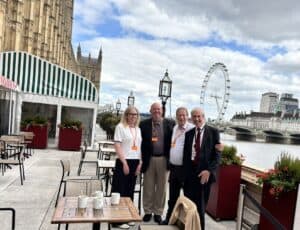
In 2025, having been approached by the leaders of the Acorn Christian Healing Foundation, GoHealth and Acorn explore how the legacy and ministry of Acorn can continue with GoHealth.
In 2026, GoHealth become custodians of Acorn’s legacy and Listening Course (due to be relaunched late 2026). GoHealth team start to gather stories to add to the Acorn legacy website – CLICK HERE
The LiFT Programme is launched
1st April 2025
At Easter 2025, GoHealth launched the LiFT Programme: an online learning experience exploring the key pillars of wellbeing through the lens of Christian faith. Developed with support from our clinical adviser, Dr Richard Pile, LiFT brings together trusted health guidance, practical approaches to habit formation, and the encouragement of learning alongside others. At its heart is a simple conviction: belonging is not an added extra to wellbeing, but one of the ways we flourish.
A New Online Learning Platform for Healing and Flourishing
5th December 2023
GoHealth launched its first self-led online course, Being Trauma-Informed, created with the Revd Hilary Ison. Built on a new learning platform designed for beautiful, person-centred courses and reflective journeys, it has since helped hundreds of people grow in trauma-informed understanding — an increasingly vital foundation for ministry and community life.
The course became the beginning of a growing digital library exploring health, faith and human flourishing. Courses can be purchased individually, while GoHealth members receive access as part of a community where learning, belonging and wellbeing come together.

Christ Church Southgate Becomes Our First Healthy Healing Hub
7th December 2021
Throughout its history, GoHealth has supported churches to become places of healing. The launch of the first Healthy Healing Hub at Christ Church Southgate brought that calling into a new era: equipping churches with the confidence, training and safeguarding needed to offer healing ministry that is prayerful, responsible and safe.
With more churches than GP surgeries across the UK, local congregations have a unique opportunity to support the health and flourishing of their communities. Each Healthy Healing Hub helps a church discern how God is calling it to respond to local needs, empowering the whole congregation to become a visible and trusted healing presence where they live.

From membership to movement
17th June 2021
The Guild has always been a membership organisation, bringing together people committed to exploring the relationship between health and faith. In response to the challenges and isolation left behind by the COVID-19 pandemic, the GoHealth Community reimagined what that membership could mean for the world today.
More than a club, it is a growing movement of people seeking to learn, connect and flourish together. Through regular resources, events, shared learning and our online Prayer Portal, members are equipped and encouraged to bring healing, hope and wisdom into their own lives and communities.
The GoHealth Community is a contemporary expression of our enduring vision: a place where health, faith and belonging meet, and where every person is invited to take part.

The GoHealth Podcast is launched
4th November 2020
The launch of the GoHealth Podcast gave our movement a new voice in the world: a place for thoughtful, honest conversations about health, faith, healing and human flourishing.
Through personal stories and expert insight, the podcast explores both hope and complexity. Conversations have ranged from how to pray for healing, racism, addiction, public health and many of the difficult questions that arise when faith meets real life.
In a noisy and often divided world, the podcast creates space to listen without judgement, remain curious, and deepen our understanding together. By 2026, episodes had been listened to more than 14,500 times — connecting a growing community of people seeking wisdom, compassion and a more honest conversation about what it means to flourish.

Our new logo is launched
4th September 2020
The launch of the GoHealth name and logo gave the Guild a fresh, contemporary identity to sit alongside our formal title, The Guild of Health and St Raphael. It expressed something important about who we had become: an organisation with renewed energy, a clear voice and a strong sense of relevance, while remaining deeply rooted in more than a century of history, wisdom and service. GoHealth helped us carry that inheritance forward – making our work more accessible to a new generation without losing the depth of the story that shaped us.

Responding to the global pandemic
23rd March 2020
In response to the health and spiritual needs of the world and our members, The Guild of Health and St Raphael begin streaming daily and then weekly prayer on social media platforms.
The Keeping the Faith reports revealed the vital role faith communities played during and beyond the COVID-19 pandemic, and the growing value of collaboration between churches, local authorities and community organisations. Their findings strengthened GoHealth’s work to connect health, faith and community, demonstrating that trusted local relationships can become powerful foundations for public health, wellbeing and lasting social change.
The Guilds reunite
1st December 2014
The Guild of Health and the Guild of St Raphael reunite in 2014 and is now at the forefront of engagement with the professional and academic world, as well as supporting individuals and churches in local expressions of the ministry of health and healing.
‘…As one new organisation we look forward to being of even greater service to help the medical professions find a place to explore the place of faith in healing, to help ministers of religion develop their knowledge of science and medicine to be understood alongside the depths of Christian spirituality, and we seek through prayer and education, to help everyone explore what it means to be “whole” in body, mind and spirit’.
Rev’d LucyAnn Ashdown sermon at the reunion of the Guilds in Chester Cathedral 2014

Denis Duncan Lecture
1st November 2014
The first Denis Duncan Lecture took place in November 2014 with the Reverend John Bell as the lecturer speaking on the theme of In Search of the Common Good.
The Revd. Dr. Denis Duncan was a Scottish minister who had a huge influence on the healing ministry. To commemorate his life, the Guild of Health and St Raphael hold an annual lecture in his name to explore all aspects of healing, health and wellbeing for Christians and churches.
Edward Wilson House was sold
1st November 2000
Edward Wilson House becomes a hub for the Guild of Health’s ministry
1st November 1980
The Headquarters offered a weekly intercession group and Eucharist. Twice a month there were group counselling, relaxation and meditation sessions. Once a month there was a tape listening and discussion time. There were regular Saturday seminars, a Tuesday evening lecture programme and counselling as required.
Challenging times for the Guild to evaluate its role in the world
1st November 1970
‘It is no longer certain that Guilds and Fellowships are wanted…Memberships of most of the healing societies tends to be on the elderly side and does not show obvious signs of self-renewal. Yet the objective of the re-establishment of the complete ministry to the sick, as part of the normal work of the Church, has been partly achieved far more is going on now than ever before. This very fact makes it harder to see what the role of our societies should be.’
Dr Martin Israel + John Gravelle 1977.
The Way of Life replaces ‘Health and Healing’ as the magazine of the Guild of Health
2nd November 1968
The first few editions of The Way of Life were produced in joint publication with the Divine Healing Mission. This partnership remained until 1974
‘As the Divine Healing Mission and the Guild of Health set ut in closer co-operation, it is to offer not only healing but Life; Life in abundance. Life in all its fullness, New Life in Christ.’ (Editorial of the first edition)
Chrism journal emerges out of the Guild of St Raphael quarterly review
3rd November 1965
The name Chrism was adopted in 1965; before then it was ‘The St Raphael Quarterly’.
The Editor of the Quarterly and then Chrism was Henry Cooper, from 1955 until just before his death in 1982.
Henry Cooper devoted almost a lifetime’s work to promoting the ministry of healing in the Church through the Guild and in 1958 played a major part in the Convocation debates on the Report to the Archbishops ministry of healing.
The vision of Chrism throughout its history has been ‘to match pastoral practice with learning from the fields of theology, ethics, medicine and health studies, to offer constructive criticism, to assess the ethical implications of healing problems and to continue to set its face “firmly against any kind of superstition or heresy based upon an unbiblical view of man.’ (Rev Martin Dudley 1991)
Global Engagement
2nd November 1960
Both the Guild of Health and St Raphael have a long history of Global engagement. The 1960s saw a surge in international relations in the healing ministry.
Canon Bird was chaplain of the Guild of Health and worked to established closer links across Europe, Canda, Bermuda and Nigeria. Mr James McGilvray, a member of the Guild was involved in the writing of The Healing Church, a publication by the World Council of Churches in 1966.

Edward Wilson House
2nd November 1952
Edward Wilson House becomes the headquarters for the Guild of Health.
Edward Wilson House (26 Queen Anne Street, London) was named after the brother of Fr Jim Wilson (1881 – 1972), Chaplain to the Guild of Health in the 1950s and 60s who left an indelible mark.
The house was named after his brother, the doctor, naturalist and artist who died with Scott of the Antarctic in 1912. The vision behind the house was for the Guild of Health to be located in the medical quarter of London where doctors and clergy could get together. The house was used for daily prayer and personal counselling under the guidance of the Chaplain.
FF Sinker 1959 -1965
4th November 1959
F.F. Sinker Peripatetic chaplain Guild of St Raphael.
F.F. Sinker travelled widely in England lecturing in theological colleges, to deanery chapters, and preaching in churches.

Father Jim Wilson 1947-1957
1st November 1947
Father Jim Wilson – much loved chaplain to the Guild of Health.
Father Jim Wilson’s influence is said to have charted the course of the Guild for the two decades after he stepped down from being the Chaplain in 1957. He was a champion of contemplative meditation as a means of healing – he was still taking meditation groups up til two weeks before his death.
‘There still seems to be a widespread belief that sickness is God’s will, and the first thing to do in every place is to break down this idea, and to search out the underlying causes of disease. From this point it becomes necessary to build up a strong faith that sickness and disease can be overcome by the power of God through prayer and meditation, and again and again one realises that the great importance of the work of the Guild is to try to teach people to live the abundant life. We are a Guild of Health before a Guild of Healing.’

The beginnings of the NHS
1st November 1947
The Guilds were concerned that the nationalisation of hospitals may lead to a less human touch and a diminished sense of vocation by those employed in the medical profession.

World Wars
2nd November 1940
During the war the Guilds operated with ‘the unshaken belief that these times call not less but more for the distinctive message entrusted to it’.
Both Guilds considered the war a moment of ‘ real awakening of interest in Healing Services and Divine help’ and that there was much work ahead for the Guilds. The Guild of St Raphael born on the threshold of WWI recognised the need for the Guild to respond to the ‘opportunities to increase the usefulness of our Guild and further to extend its work.’
The Churches’ Council of Healing was set up
1st November 1944
The Churches’ Council of Healing had slightly more success with the British Medical Association than the Guilds, the council was set up in 1944 to bring together everyone interested in the healing ministry, including both Guilds, by the Archbishop of Canterbury William Temple.
Response to the Disarmament Conference in Geneva in 1932
2nd November 1932
In response to the rumblings of war in the 30s and in particular the Disarmament Conference held in Geneva in 1932 a very powerful piece was written encouraging Guild of Health members to educate themselves in the things that are for peace and to wish and pray for a ‘peaceful world-order:’

The first St Raphael Quarterly is published
1st January 1925
The first St Raphael Quarterly is published in 1925
The guild of St Raphael Mats for Africa project also begins in the 1920s.
This involved Guild groups and members donating money for hospitals in Africa and in particular for the provision of mats for patients to lie on. The supporters of this endeavour were animated and excited at the prospect of the healing that might happen on those mats. This money was also used for the provision of general medical supplies, for example, in 1931 £80 was sent for to be shared among four diocese: Zanzibar, Masasi, Northern Rhodesian and Nyasaland.

The Guild of St Raphael emerges out of the Guild of Health
3rd January 1920
Founded by Bishop Hough, suffragan bishop in the Southwark diocese and Canon Roseveare of St Paul’s Deptford. The other driving personality behind the foundation of the Guild of St Raphael was Miss Caroline Biggs, the Guild’s Honorary Secretary.
‘The Guild of St Raphael came into being as a result of a split in the Guild of Health…Although remaining for fifty years on good terms with its parent body it is still clear that there is a need for a sacramental ministry to the sick which an interdenominational body cannot fully foster. This is the justification for the Guild of St. Raphael’s continued existence.’ Chrism editorial, 1965

Harold Anson becomes chair
2nd January 1920
Harold Anson becomes chair of the Guild of Health. He remained the chair for two decades, until 1930
Geoffrey Harding’s 75th anniversary account has Harold Anson becoming chair after the war until 1930. ‘What in effect was the second founding of the Guild was largely due to him.’
He ‘longed to see healing regarded as the ‘salvation’ of the whole personality, not body only or spirit only, but the totality of the person, so that the Church should envisage ‘salvation’ as that state in which a person is set free from disease, ignorance, superstition and fear to serve God in freedom.’ (Looking Forward p.178)

The Guild of Health becomes ecumenical
22nd October 1913
At Lily Dougal’s urging the Guild of Health becomes ecumenical.
She wrote Guild of Health Pamphlet. No 1 ON St Luke’s Day 1913 on The Functions of the Guild of Health and it was frequently reissued.
‘There were a number of man [at the Swanwick Conference on Social Service] who were determined that I should help them to draw up a basis for the new Guild of Health, and we had private confabulations at all hours…we got our minds cleared up on the health subject.’ Lily Dougall, ‘Religious Experience and the New Woman’
Joanna Dean

The Guild of Health and St Raphael is formed
1st January 1904
The Guild of Health and St Raphael, as it is known today, was formed in 1904 to bring together members of the clergy and medical professions together to study and promote the healing ministry of the Church. It is the oldest organisation in the UK working in the field of Christian healing.
The Guild of health was started by the famous Anglican scholar and liturgist, Dr Percy Dearmer, prominent Christian socialist, Conrad Noel and Harold Anson who became the chair of the Guild from 1908 – 1928.
Noel and Anson outlined two particular reasons for beginning the Guild; they saw the surge of interest in healing outside the church, through Christian Science and other health movements, as being ‘driven into heresy by the Church herself having forgotten to preach spiritual healing and having lost the power to practise it.’
And in response to a theology within the Church that was resigned to suffering and disease as ‘being something sent by God for our good, or else a method of distracting men’s [sic] attention from the sorrows and injustices of this world by rising it upon a life to come, which made this world of comparatively of no account.’ The Guild intended to challenge this ‘gospel of the value of disease, of injustice, of disappointment as the necessary education for the spiritual life.’
‘Christ healed the sick and instructed his followers to do the same. Why was the Church no longer doing it?’ Rev’d Geoffrey Harding, The First 75 Years of the Guild of Health