



We live in a culture enslaved to speed. We demand immediacy, yet the deepest treasures of life—growth, healing, transformation—cannot be hurried. Creation itself is the patient labour of ages, shaped through countless millennia. The olive tree, once planted, must endure long seasons of silence before it bears its first fruit.
Those who have walked the hard paths of illness, grief, or inner change know that healing never comes on command. It ripens only in its own time. In an age overshadowed by war, in days bleak and uncertain, waiting can feel unbearable. Yet even here lies a hidden grace: waiting becomes the hour of mending wounds and searching the soul—not only for individuals, but for whole communities.
Waiting as Recognition of God’s Sovereignty
To wait is to release our grip on control, to yield to the sovereignty of God over our restless striving. Humanity suffers from three grave afflictions: selfishness and ego-centrism; exclusivism that divides and excludes; and indifference to the suffering of others.
Human pride clings fiercely to the self, yet waiting loosens its hold. It heals us of egocentrism, awakens us to inclusivity, and nurtures compassion for others.
The psalmist declares: “I wait for the Lord, my whole being waits, and in his word I put my hope” (Psalm 130:5). Waiting is no passive resignation, but an act of trust—sometimes even a holy struggle. Like Jacob wrestling at the riverbank, waiting becomes encounter: until, limping yet blessed, we know ourselves held in the hand of God.
Waiting in Our Time
Our waiting today is often not chosen but imposed: waiting for news of loved ones in Ukraine, in Gaza, across the Middle East; waiting for peace, for justice, for the world to be made whole. This waiting wounds; it is excruciating. Yet it is also the soil where hope can take root. As Isaiah proclaims: “Those who wait for the Lord shall renew their strength; they shall mount up with wings like eagles” (Isaiah 40:31).
Waiting Together
No one should wait alone. Jews wait for the Messiah; Christians for the coming of Christ; Shia Muslims for the twelfth Imam; Sunnis and Yazidis for the fulfilment of time. Even those without faith wait—for a better tomorrow, for healing, for peace.
And Paul reminds us that waiting is not only human: “The whole creation has been groaning as in the pains of childbirth” (Romans 8:22). The earth itself waits, scarred by war and violence, by greed and ignorance, yearning for redemption. To wait together is to join a great chorus of hope—humanity and creation alike longing for God’s healing.
Waiting with GoHealth
In this Advent season, the GoHealth community invites us to rediscover waiting as a discipline of healing: waiting in prayer, waiting in silence, waiting in fellowship. Healing is not always the gift that appears at the end of waiting; more often it is found within the waiting itself.
A Hopeful Invitation
The Church has always known the sanctity of waiting. Lent waits for Easter; Advent for the Incarnation; every Eucharist waits for the heavenly feast. In each season, the past is remembered, the future anticipated, and the present sanctified.
We live in troubled times, yet in this sacred season waiting may become our strength.
A story is told of a teacher who asked his students: “When can we say that night is over and day has dawned?”
One answered: “When we can tell a dog from a sheep.”
Another: “When we can distinguish a man from a woman.”
Another: “When we can discern European from non-European.”
Another: “When we can tell rich from poor, educated from uneducated, gay from straight.”
The teacher shook his head: “No. Night has ended only when you can look into the eyes of another human being and see in them your sibling. Then, and only then, can you say the day has come.”
It is my prayer that in this Advent waiting we may learn to look into the eyes of our fellow beings—human, animal, bird, and tree—and see in them our kin. Then our waiting will not be wasted. With the dawn of Christmas, our waiting itself will become our healing.
Share your thoughts
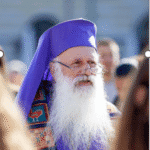
Share your response to H.E. Bishop Malkhaz Songulashvili’s reflections and wisdom on waiting
“This waiting wounds; it is excruciating”. Wow, that touched deep in me. In recognition, that is. For me currently the pain twists and turns in the waiting with my mother as her capacities become diminished: de-mentia, the mind’s ongoing loss of itself. And, I confess, I wish for it to stop as soon as possible, and the guilty pain in that wish is excruciating indeed. Because faith in God’s goodness tells me that the number of her days is in God’s hands; her life is a blessing, and not mine to wish away.
How long, oh Lord? Not, then, how long will her life be, but how long until we find the “hidden grace”. Might we even find this together, my mother and I? These words offer hope, which I so need.
Thank you.
Thank you, I don’t have the words to explain how this has connected with me, but I know that as I head out with my dogs this morning I will take this with me, to contemplate and mull over. Thank you so very much, I feel like I have been nourished.
‘Waiting in hope’ was the theme at our Cafe Church this week, as we considered how we could let go of our need to always feel in control.
Thank you so much for this reflection.
This is rich and profound. These reflections have been so good