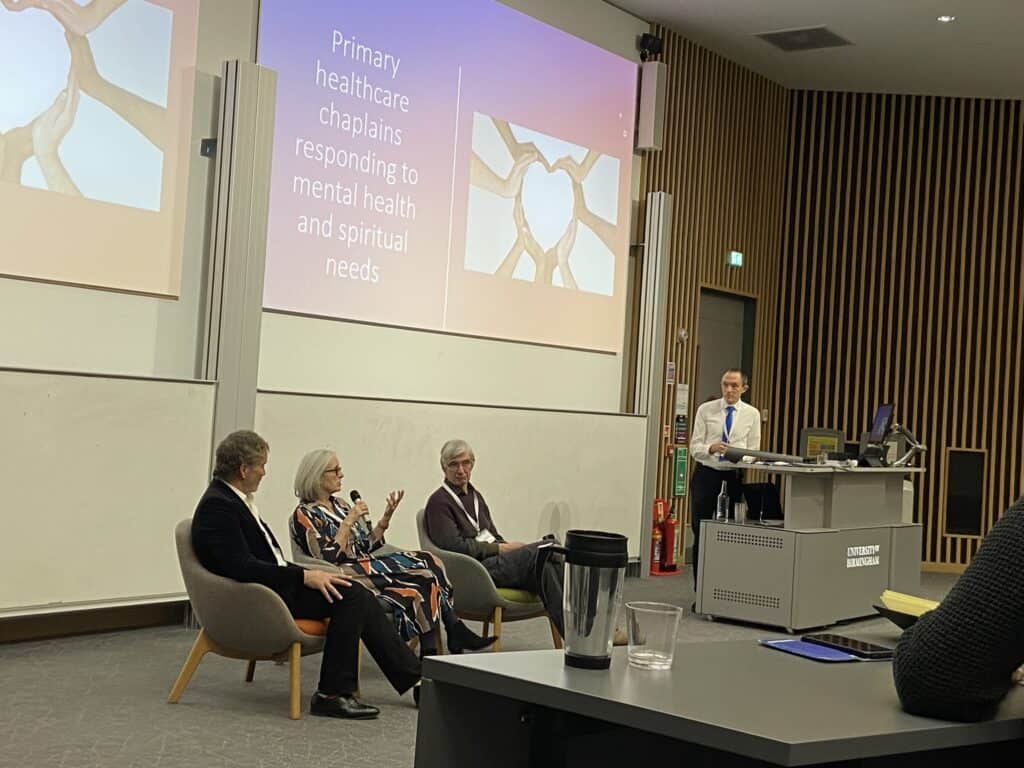

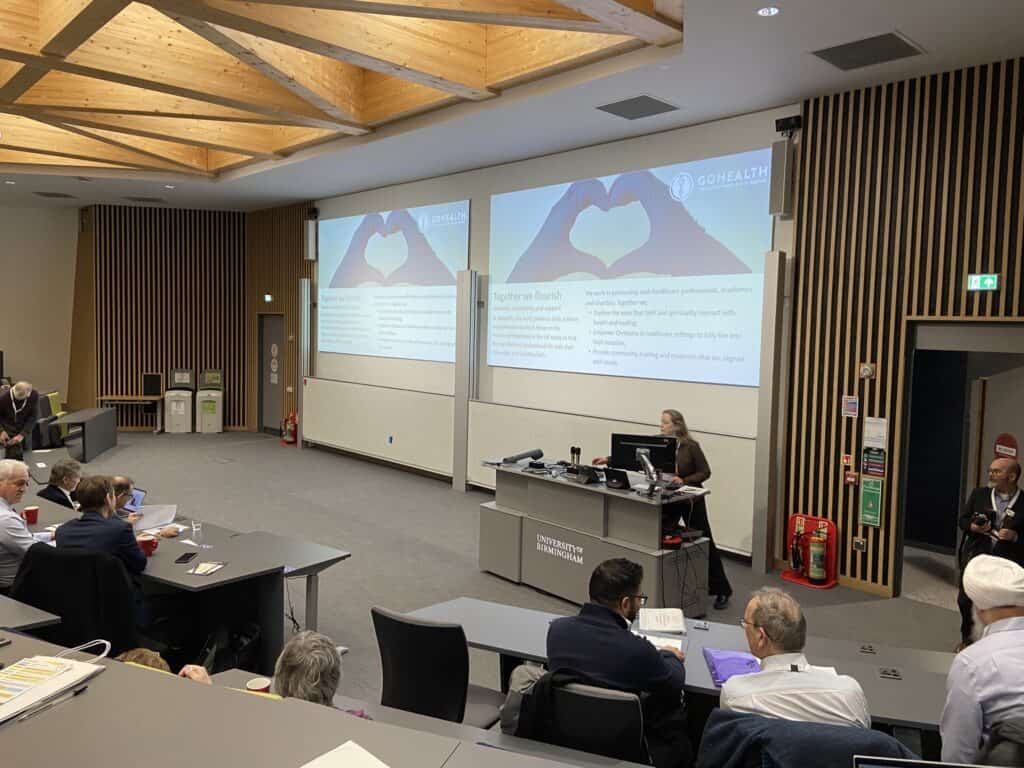
One of the first people that I met was a medical student who recently returned to their studies after a prolonged period of absence due to bereavement and mental health struggles. They told me that their experiences of loss and ill health brought them to a realisation that to be a good doctor, they would have to explore what wasn’t currently part of the syllabus at medical school: the spiritual aspects of human health and healing. She was fired up, inspired by her experience of ill health and loss, to be a better healer and to understand how chaplains might work with people in a medical setting.
In the conference room, there were keynote speakers and other experts who had made this realisation decades ago (including Ross Bryson, Chris Cooke and David Smart, to name just a few. See below for links to their work). These and many others had worked hard for years to synthesize an approach to medicine that took seriously the whole person, through writing, training courses and organisations (such as WPH and ACGP).
The headlines on the morning of the conference were of critical incidents declared across the NHS which was dealing with a combination of a difficult flu season and the cold weather. This is on top of the known crisis within primary care and the government debates over funding the NHS. There was a palpable feeling amongst the delegates: NOW is the moment that the NHS must take seriously the whole person approach to health and healing.
The role of faith organizations had been positively highlighted in the pandemic, where their ability to respond to need in the community was positive and researched in the Keeping the Faith reports. Importantly, this report found that fear over proselytization was low. The pandemic also highlighted the role that chaplains play within hospital settings, and in particular the support that they give the staff.
Facts and figures were wheeled during the day out about the ways that a spiritual approach can aid healing and lead to wellbeing. My favourite was that those who are happier are more productive – and they have the stats to show it!
But what really drove the urgency and the potential for deeper collaborations between medicine and faith was the stories that we heard. A psychologist’s story of listening to the tale of a life riven with abuse and simply holding a warm steady non-judgemental presence when the anger and truth exploded from her heart; the healing journey that began when one high profile and outwardly successful person admitted to their secret struggle; the feedback snippets that hint at the depth of the healing: ‘you helped me find a way forward’, ‘you brought calm to a troubled mind’. One GP said (describing the immense pressure of running a surgery): ‘chaplaincy has been our answer’.
When there is just one person in a surgery who doesn’t say ‘What’s the matter with you?’, but rather, ‘What happened?’ and then ‘tell me more’ and then ‘tell me more’. Then stories are shared, people are seen, and healing journeys can begin.
This was all holy ground stuff.
But it is tough – not least in the language that is used around the healing that chaplaincy and a whole person approach uses. Indeed, even bringing up the topic remains tricky and sometimes divisive. In conversation, two doctors agreed that it is far easier to talk about sex than spirituality in the GP surgery. The searching in the room was about the practicalities of chaplaincy but, at a deeper level, it was about how healers, whether doctors or chaplains, bring our healin gifts from a place of shared humanity rather than skill sets and strategies.
One talk in particular, by Dr. David Smart and Dr. Paul Turner, set out the ways that church and GP surgery can join forces to meet need. There are more churches in our country than GP surgeries. Everyday in the conference could see this vast potential for collaboration, where churches could be hubs for healing for the whole community, whether through social prescribing projects, chaplaincy provision or the myriad ways that churches offer health activities. David spoke of the Gym Chapel (see below) and many other examples of where the church becomes a place of healing and health, in this life and the next.
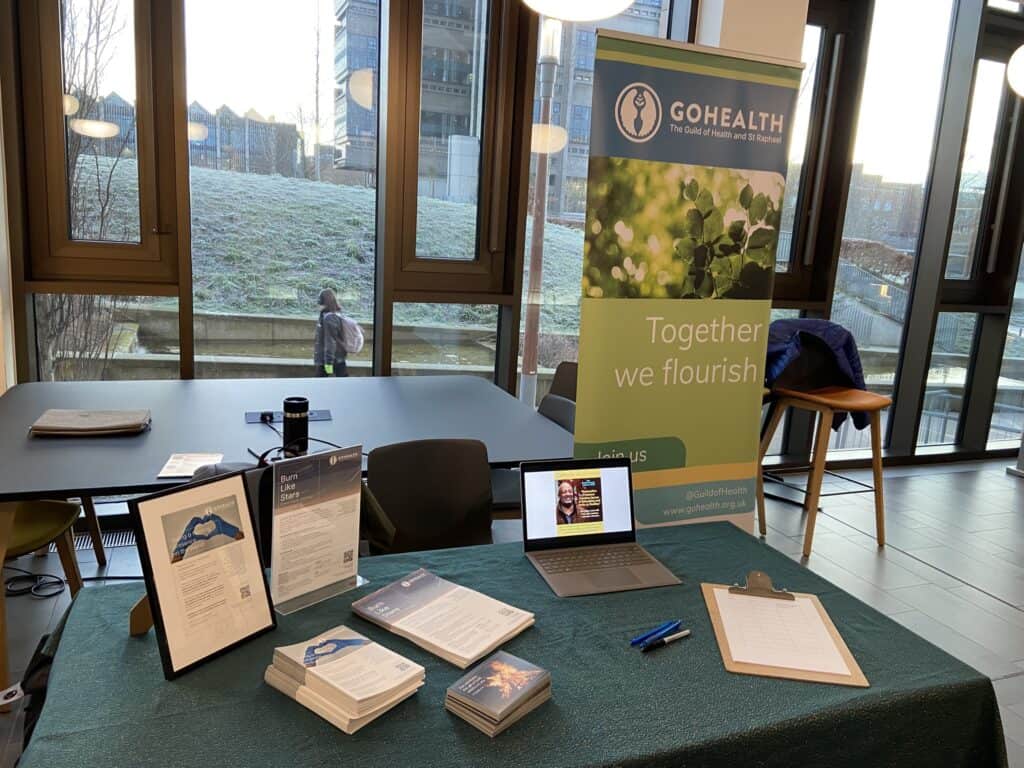
GoHealth is here to support anyone seeking to link together faith and health, in particular those working in healthcare and those running churches:
- Want to start a wellbeing hub, check out the Everyday healing course and the Healthy Healing Hub network;
- Want to explore the role of chaplaincy or deepen your practice, see The Chaplaincy Course;
- Worried about burning out in healthcare or leadership, check out our self led online course exploring how to work holisitcally, Burn Like Stars
- Seeking a community that take seriously the connections between faith and healing, join The GoHealth Community for resources, inspiration and connection.
The conference was centred around two clear questions – what is it that you hope for and why are you here?
At GoHealth we hope for is flourishing communities made up of flourishing individuals. Join us and we will resource you to explore what this means – why not simply join the mailing list to stay in touch.
We look forward to coming alongside you or your organisation, and together seeking flourishing for all in the name of Jesus Christ.
Here are some of the organisations that were part of the conference:
- The Association of Chaplaincy in General Practice: https://www.acgp.co.uk/
- Brighter Days wellbeing and resilience training set up by Patrick Reagan OBE, founder of Kintsugi Hope. https://www.brighterdays.life/
- The Chapel Gym – closed as church but reopened as a gym. It kept a place of prayer and now has grown into a place where people can improve their physical, emotionals and spiritual health, and now has a team of sports ministry chaplains. Community Gym in the Centre of Corby | The Chapel Gym
- The Health Creation Alliance is the leading national cross-sector movement improving health and wellbeing and reducing health inequity through Health Creation. https://thehealthcreationalliance.org/
- Action for Happiness – We are a movement of people taking action to create a happier and kinder world, together. Happier Kinder Together | Action for Happiness
- Prime International: Partnerships in International Medicine Education https://www.prime-international.org/theprimenetwork.htm
- Action for Happiness – We are a movement of people taking action to create a happier and kinder world, together. Happier Kinder Together | Action for Happiness
- The National Academy for Social Prescribing | NASP
- Churchworks and their work with Theos on Social Prescribing https://www.churchworks.org.uk/social-prescribing
- Faithaction covenant: The Faith Covenant is a joint commitment between faith communities and local authorities to a set of principles that guide engagement, aiming to remove some of the mistrust that exists and to promote open, practical working on all levels. https://www.faithaction.net/working-with-you/appg-on-faith-and-society/covenant/